
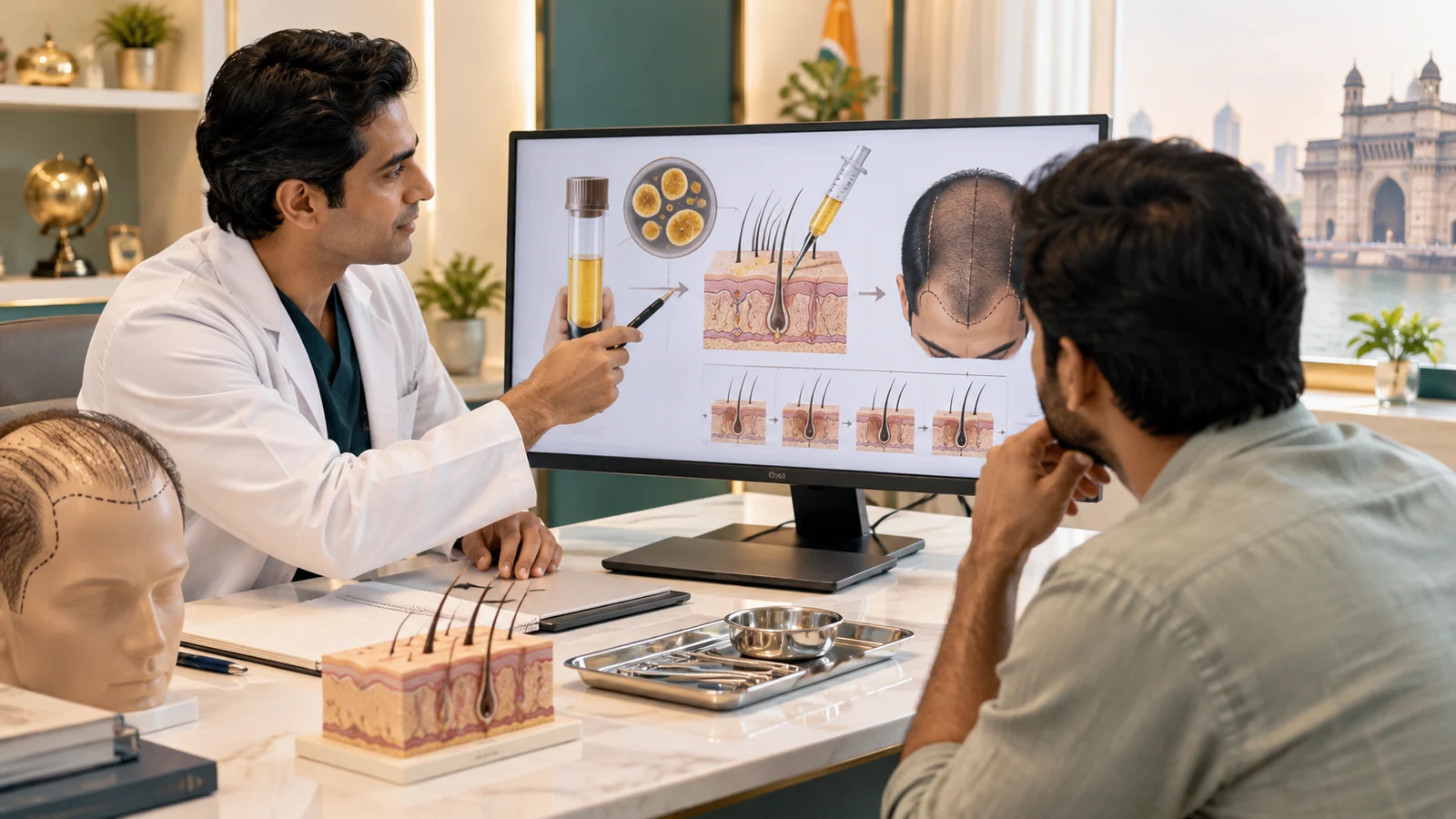
Every week, patients walk into my consultation room in Chandigarh with the same question: “Doctor, should I get PRP with my hair transplant — or is it just an add-on to make the bill bigger?”
It is one of the most honest questions I hear. And it deserves an equally honest answer. I am Dr. Nav Vikram, hair restoration surgeon at NeoGraft Hair Clinic in Chandigarh. After 15 years and more than 10,000 hair restoration procedures, I want to cut through the noise and give you the clinically accurate picture — what PRP can do, what it cannot do, how we integrate it into our NeoPlatinum FUE technique, and what to ask before agreeing to any PRP-based treatment in India.
Understanding PRP: The Basics Every Indian Patient Needs to Know
PRP stands for platelet-rich plasma. It is derived from your own blood. A small amount — typically 15–30 ml — is drawn from your arm and spun in a centrifuge machine at high speed. This separates the blood into layers; the concentrated platelet layer is collected and prepared for injection.
Platelets contain dozens of growth factors — proteins that signal the body to repair, regenerate, and build new tissue. When injected into the scalp, these growth factors stimulate the dermal papilla cells at the base of your hair follicles, potentially extending the anagen (growth) phase and improving follicle health. In the Indian context — where scalps face hard water stress, dietary protein gaps, and early genetic DHT sensitivity — a growth-factor-rich environment makes a measurable difference to follicle resilience.
However, PRP is not a cure for androgenetic alopecia. It does not block DHT. It does not permanently restore dormant follicles. Used alone, its effects on significant hair loss are modest and temporary. The real power of PRP emerges when it is integrated into a surgical protocol — specifically into the graft handling and implantation process during a hair transplant.
The DHT Connection: Why PRP Alone Is Never Enough
Most patients who come to me asking about PRP have pattern baldness — androgenetic alopecia driven by dihydrotestosterone (DHT), a potent derivative of testosterone produced by the enzyme 5-alpha reductase. DHT shrinks hair follicles in genetically susceptible zones over time — a process called miniaturisation. Once a follicle miniaturises fully, it cannot regrow hair, regardless of how much PRP is injected.
PRP can slow miniaturisation in early-stage hair loss by creating a growth-factor-rich environment around weakened follicles. In this context, it has a legitimate preventive role. But once significant baldness is established, PRP sessions alone will not give you your hair back. At NeoGraft, we address DHT directly — through our NeoDHT technique’s DHT-blocking pre-treatment protocol — while simultaneously using PRP as a biological accelerator within the surgical process.
What Patients Get Wrong About PRP for Hair in India
Four misconceptions come up repeatedly in my consultations:
- PRP will regrow my lost hair permanently. PRP strengthens existing weak follicles and extends their growth cycle — but requires ongoing maintenance. It does not create new follicles where none exist.
- Any PRP is the same. The quality of PRP depends entirely on centrifugation protocol and platelet concentration achieved. PRP administered in beauty parlours or non-medical settings is both dangerous and largely ineffective — a concern that led to India’s stricter hair procedure regulations in 2026.
- PRP during hair transplant is just a gimmick. The opposite is true when used correctly. Research consistently shows that grafts stored in PRP-enriched media have superior survival rates. PRP before implantation reduces inflammation and enhances early follicle vascularisation. These are measurable, clinical outcomes.
- I can do PRP at home with kits I find online. Home kits cannot achieve the centrifugation quality required for therapeutic platelet concentration — and improperly handled blood products carry serious infection risk.
The NeoGraft Approach: How PRP Powers NeoPlatinum FUE
At NeoGraft, we offer two proprietary techniques: NeoDHT FUE and NeoPlatinum FUE. NeoPlatinum is our premium-tier procedure, and it integrates PRP at three distinct stages of the hair transplant — not as an afterthought, but as a core part of the surgical protocol.
“We did not add PRP to a standard FUE procedure. We built a procedure around PRP’s genuine biological benefits — at extraction, storage, and implantation. That distinction is everything.”
— Dr. Nav Vikram, NeoGraft Hair Clinic, Chandigarh
- Stage 1 — Graft Storage: Extracted follicular units are placed in PRP-enriched preservation media rather than standard saline. This keeps grafts metabolically active, reduces oxidative stress, and extends safe out-of-body time — resulting in higher graft viability at implantation.
- Stage 2 — Recipient Site Preparation: Before creating implantation channels, we inject PRP into the recipient zone. This floods the area with growth factors, reduces the inflammatory response that follows channel creation, and primes the tissue environment to receive grafts optimally.
- Stage 3 — Post-Implantation Acceleration: A final PRP application after graft placement supports early vascularisation — the process by which transplanted follicles develop a blood supply and take root in the new location.
All phases of NeoPlatinum FUE are performed by Dr. Nav Vikram — not technicians. This matters fundamentally for outcome quality and consistency.
What to Expect: Before, During, and After PRP-Integrated Hair Transplant
Before the procedure: A detailed scalp and blood analysis assesses your platelet count, hair loss pattern, donor density, and overall health. Patients stop supplements affecting platelet function (high-dose omega-3, vitamin E) 7–10 days prior.
During the procedure: NeoPlatinum FUE is performed under local anaesthesia, typically over 6–8 hours. Blood is drawn at the session’s start and PRP prepared in-house using our clinical centrifuge. The procedure is virtually painless — many patients watch a film or rest during the session.
After the procedure: Recovery is faster with PRP integration. Most patients return to desk work within 2–3 days. New hair growth begins at 3–4 months, meaningful density is visible by 6–8 months, and full results appear at 12 months. Depending on scalp health baseline, 1–2 standalone PRP booster sessions at 3 and 6 months may be recommended for adjacent zone preservation. Explore post-transplant care products at store.myneograftindia.com.
Frequently Asked Questions About PRP Hair Transplant in India
Is PRP hair treatment safe?
Yes, when performed in a medical setting using your own blood. Because PRP is autologous — derived from your own body — there is no risk of allergic reaction or rejection. Risks arise from non-medical practitioners using substandard preparation equipment.
How many PRP sessions do I need for hair loss without surgery?
For early-stage hair thinning (Norwood 1–2), a typical protocol involves 3–4 initial sessions spaced one month apart, followed by maintenance every 3–6 months. Expect reduced shedding and improved hair calibre — not dramatic regrowth from nothing.
What is the cost of PRP hair transplant in India?
Standalone PRP sessions at reputable medical clinics typically range from ₹5,000–₹15,000 per session. When integrated into a NeoPlatinum FUE transplant at NeoGraft, PRP is part of the surgical package. Visit our hair transplant cost page for detailed information.
Does PRP work for women’s hair loss?
Yes, often with excellent results. Women’s hair loss frequently involves diffuse thinning rather than complete follicle death, making PRP a particularly effective therapeutic tool. We combine it with our female hair transplant protocols for patients requiring both restoration and preservation.
Can PRP prevent future hair loss after a transplant?
PRP can support the health of native hair adjacent to the transplanted zone when administered as follow-up sessions. It works best combined with our Hair Loss Protocol, which includes DHT management to prevent further miniaturisation of non-transplanted follicles.
PRP is not magic, and it is not a gimmick. It is a legitimate biological tool that delivers its full potential only when used correctly, in a medical setting, by a qualified surgeon who understands where in the treatment process it creates genuine value. If you are ready for a permanent solution with maximum density, NeoPlatinum FUE at NeoGraft Chandigarh integrates PRP’s power into every stage of your procedure — under the hands of a surgeon who has been doing this for 15 years.
📞 Book a free consultation at NeoGraft Hair Clinic, Chandigarh
🌐 myneograftindia.com | 📱 WhatsApp: +91 904-199-9199
🏥 SCO 3009-3010, Sector 22D, Chandigarh 160022