
By Dr. Nav Vikram Kamboj, Director, NeoGraft Hair Clinic, Chandigarh
There is one number that determines whether your hair transplant succeeds or fails — and most clinics in India will not tell you what it is until after you have paid.
That number is your graft survival rate.
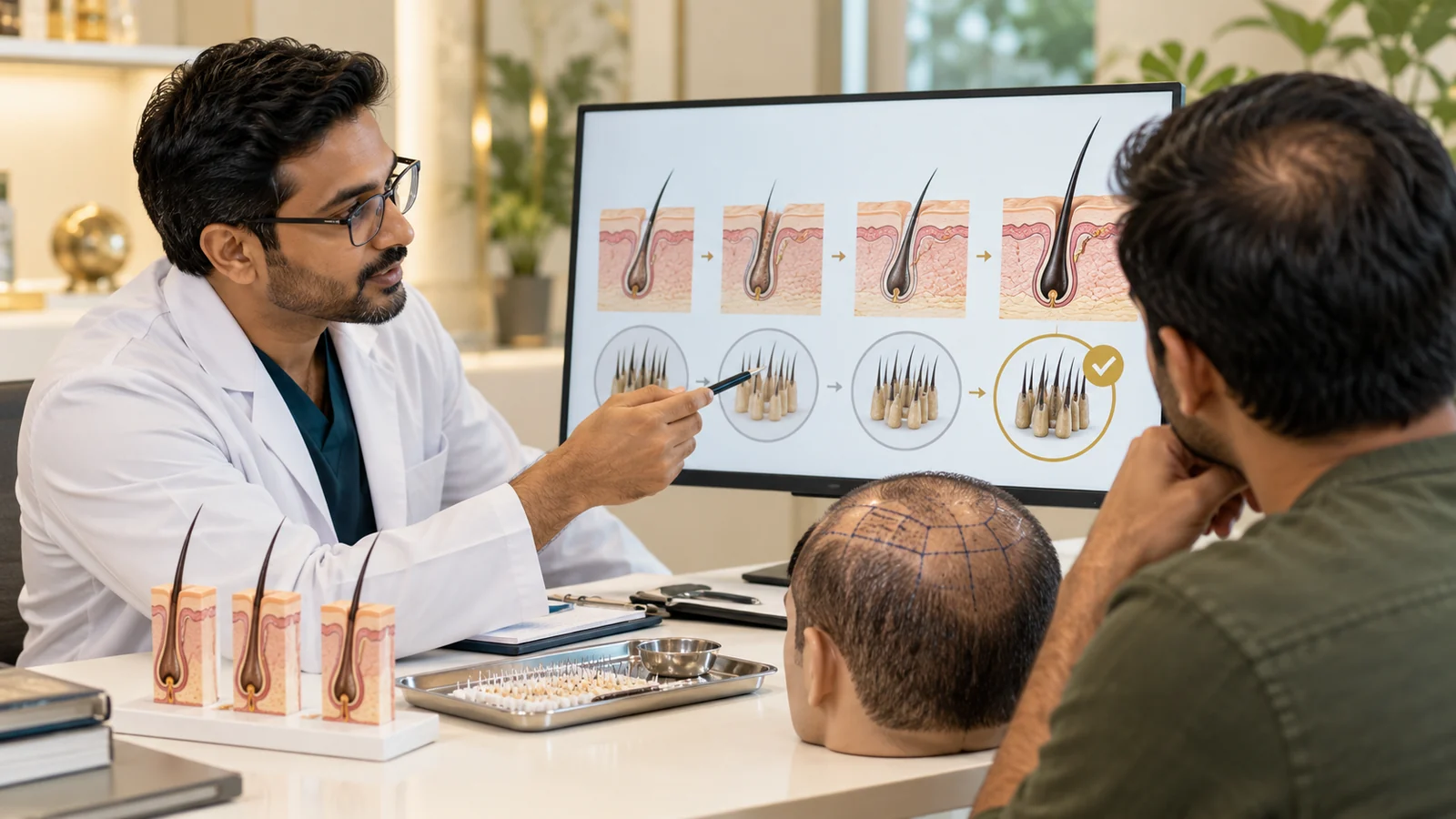
It is the percentage of extracted hair follicles that survive the entire procedure — from the moment they leave your scalp to the moment they are safely implanted back in. And the difference between a 75% graft survival rate and a 99% graft survival rate is not just a statistic. It is the difference between thin, patchy results and a full, natural-looking hairline.
At NeoGraft Hair Clinic in Chandigarh, we have performed over 10,000 hair transplant procedures across 15+ years. We developed two proprietary techniques — NeoDHT FUE and NeoPlatinum FUE — specifically because we were unsatisfied with the graft survival outcomes we saw happening across India. In this article, I want to explain the science clearly so you can ask the right questions before choosing any clinic.
Understanding Graft Survival: The Science Behind the Number
A hair graft is a living biological unit. Once it is extracted from your donor area, it is outside your body — exposed to temperature changes, oxygen deprivation, mechanical damage, and dehydration. Every minute it spends outside the scalp is a minute it is under stress.
Graft survival rate refers to what percentage of those extracted follicles survive long enough to establish a new blood supply in the recipient area and begin growing hair. A graft that does not survive simply dies. You will never see hair from that follicle again.
The standard FUE (Follicular Unit Extraction) technique, as practised in the majority of Indian clinics today, achieves a graft survival rate of 75–85%. That means in a 3,000-graft procedure, 450 to 750 grafts may die before they ever grow a single hair. You paid for them. You went through the procedure for them. But they simply did not make it.
Why? Three primary reasons:
1. Extraction trauma: Traditional FUE uses high-speed rotary punches — some operating at 1,500–3,000 RPM — that generate heat and mechanical force. This physically damages the follicle at the moment of extraction.
2. Out-of-body time: In large procedures, grafts extracted early may wait 3–6 hours in a holding solution before implantation. During this waiting time, cellular damage accumulates rapidly. Every 30 minutes of delay matters.
3. Storage solution quality: Most clinics store grafts in basic saline. Saline can maintain grafts for a short period, but it lacks the buffering agents, growth factors, and temperature regulation that follicles actually need to stay viable.
The Indian Patient Context: Why Graft Survival Matters More Here
India has specific factors that make graft survival a more critical conversation than in Western countries.
Hard water and DHT sensitivity: North Indian men — particularly from Punjab, Haryana, Chandigarh, and Delhi — often have higher DHT sensitivity combined with the damaging effects of hard water on hair follicles. This means their donor area hair, while strong, may carry more cellular stress before extraction even begins.
High graft count requirements: Indian men with Norwood Grade IV–VI hair loss typically need 3,000–5,000 grafts per session. At this volume, the difference between 80% and 99% survival is staggering. In a 4,000-graft session, an 80% survival rate means 800 dead grafts. At 99%, only 40 grafts are lost.
The Science Connection: How NeoDHT FUE Addresses Graft Survival
At NeoGraft, our NeoDHT FUE protocol was built specifically to maximise graft survival at every stage of the procedure.
Stage 1 — Extraction precision: NeoDHT uses proprietary nano-motors operating at 600–700 RPM — a fraction of the speed used in standard FUE. This dramatically reduces heat generation and mechanical trauma at the moment of extraction.
Stage 2 — Graft storage: Extracted grafts are stored in specialised culture media — not basic saline. This media maintains osmotic balance, provides cellular nourishment, and is temperature-regulated throughout the procedure.
Stage 3 — No-touch implantation: The “no-touch” principle means grafts are handled exclusively via the implanter device, never exposed to forceps or direct finger contact.
The result: NeoDHT FUE achieves a verified graft survival rate of 99–100% — the highest documented in India. Our NeoPlatinum FUE technique achieves 94–95% graft survival.
What Patients Get Wrong About Graft Survival
I have heard these misconceptions in consultations from patients across India for 15 years. Let me address the most common ones directly.
“The clinic said they give a guarantee — that must mean high survival.” A “guarantee” usually means the clinic will redo the procedure if results are poor — not that they will achieve high graft survival in the first place.
“More grafts = better results.” A patient from Lucknow came to us after a “4,500 graft” procedure at a budget clinic. His actual useful growth was equivalent to approximately 2,800 grafts. More grafts extracted at lower survival rates will always underperform fewer grafts extracted at maximum survival rates.
“All FUE is the same.” FUE is a category — like “surgery.” Within that category, there is enormous variation in precision, technology, and outcomes. NeoDHT and standard FUE are both called “FUE” but they produce meaningfully different graft survival results.
The NeoGraft Approach: NeoDHT + NeoPlatinum FUE
Every procedure at NeoGraft Hair Clinic is performed by Dr. Nav Vikram Kamboj personally — not delegated to technicians. This is a non-negotiable commitment at our clinic.
NeoDHT FUE is our premium technique for patients seeking maximum density and permanence — 99–100% graft survival, nano-motor extraction and no-touch implantation. Recommended for younger patients (25–38), Norwood Grade III–V.
NeoPlatinum FUE delivers 94–95% graft survival through optimised extraction speed, premium graft storage, and surgeon-performed implantation. Ideal for Norwood Grade II–IV.
Read detailed technical descriptions: myneograftindia.com/neo-dht-hair-transplant/
Patient Timeline: What to Expect
Procedure Day: Under local anaesthesia. NeoDHT FUE sessions run 6–8 hours for 2,500–4,000 grafts. You are awake and comfortable throughout.
Week 1–2: Transplanted area crusts and sheds. This is normal — the hair shaft sheds but the follicle root survives (shock loss).
Month 3–6: New hair growth begins. Fine and lighter in colour initially.
Month 6–12: Hair thickens, darkens, and matures. 70–80% of final result visible by month 9.
Month 12–18: Full maturation and final density assessment.
Frequently Asked Questions
What is a good graft survival rate for a hair transplant in India? Standard FUE achieves 75–85%. NeoPlatinum FUE achieves 94–95%, and NeoDHT FUE achieves 99–100%. Always ask a clinic for their specific documented graft survival rate.
How do I know if my grafts survived? New hair growth beginning between months 3–6 is the clearest sign. A consultation at the 6-month mark with comparative photography is the best assessment.
Why do some hair transplants fail completely? Complete failures are typically caused by severely low graft survival combined with poor patient selection, wrong angle/direction placement, or post-procedure infection.
Does the storage solution really matter? Yes — significantly. Grafts in basic saline experience rapid cellular degradation after 2–3 hours. Specialised culture media maintain viability substantially longer.
Is 1,000 grafts at 99% better than 1,500 at 70%? Yes — 990 viable grafts from the first scenario vs ~1,050 from the second, but the second depletes 50% more donor area permanently.
Can I improve graft survival after the procedure? Avoiding sun, not touching the transplanted area, sleeping at 45 degrees, and avoiding strenuous activity in the first 14 days all support graft establishment.
Conclusion
Before you book a hair transplant in India, ask one question: “What is your documented graft survival rate?”
Graft survival is the single most controllable variable in hair transplant outcomes. At NeoGraft Hair Clinic in Chandigarh, we have dedicated 15 years to engineering procedures that protect every graft from extraction to implantation. You deserve to understand the science behind your decision.
Book your free consultation at NeoGraft Hair Clinic, Chandigarh.
Website: myneograftindia.com | Phone: +91 9041999199
SCO 3009-3010, Sector 22D, Chandigarh 160022 | 4.8 stars / 1,517 reviews