
I want to be honest with you before you read another word.
You’ve probably already tried something — a shampoo, a supplement, an oil your mother recommended, maybe even a medicine from a dermatologist. And if you’re still reading about hair loss treatment in India, it’s because whatever you tried either didn’t work, didn’t work well enough, or stopped working the moment you paused it. That’s not your fault. At NeoGraft Hair Clinic in Chandigarh, I’ve assessed over 10,000 patients in the last 15 years — and what I’ve learned is this: most people are either using the wrong treatment for their type of hair loss, or they’ve waited too long before they started the right one.
Understanding Hair Loss in India — Why the Indian Context Matters
Hair loss doesn’t happen the same way everywhere. Indian men, in particular, have a higher genetic predisposition to androgenetic alopecia (male pattern baldness) driven by dihydrotestosterone — or DHT. This is the same hormone responsible for the aggressive, early-onset baldness you see so commonly in Punjab, Haryana, and across North India.
On top of this genetic sensitivity, Indian patients deal with specific environmental triggers that accelerate hair loss. Hard water (high calcium and magnesium content) is found in most Indian cities including Chandigarh, Delhi, and Mumbai. Studies show hard water causes increased hair shaft roughness, breakage, and over time, follicle stress. Urban air pollution is another compounding factor — particulate matter deposits on the scalp, disrupts the scalp microbiome, and increases oxidative stress in follicles. Nutritional deficiencies — particularly iron, Vitamin D, and protein — are disproportionately common in Indian vegetarian diets, and all three have direct roles in hair growth cycles.
The DHT Connection — The Root Cause Most Treatments Miss
If you have male or female pattern hair loss, DHT is almost certainly the central character in your story. DHT (dihydrotestosterone) is a metabolite of testosterone, produced when the enzyme 5-alpha reductase converts testosterone in the scalp. In genetically sensitive individuals, DHT binds to follicle receptors and shrinks them over time — a process called miniaturisation. With each growth cycle, the hair produced becomes thinner, shorter, and eventually the follicle stops producing hair entirely.
Here’s the critical point that most hair loss treatments in India miss: they address the symptom (thinning hair) without addressing the mechanism (DHT-driven miniaturisation). This is why Minoxidil stops working the moment you stop using it — it improves blood flow to follicles but does nothing to block DHT. At NeoGraft, we built our proprietary NeoDHT FUE protocol specifically around this mechanism — combining a DHT-blocking pre-treatment with precision extraction that achieves 99–100% graft survival.
Medical Hair Loss Treatments in India — What Works and What Doesn’t
Finasteride and Dutasteride
Prescription-only oral medications that block 5-alpha reductase — the enzyme that converts testosterone to DHT. Finasteride reduces scalp DHT by approximately 70%. Dutasteride blocks both type I and type II pathways, achieving 90%+ DHT suppression and is increasingly my preference for Indian male patients. Combined with Minoxidil, 85–90% of men halt progression and about 60% see measurable regrowth over 12 months.
Minoxidil
The most widely used hair loss treatment in India. Available as topical 5% or oral low-dose (2.5–5mg). It dilates blood vessels around follicles, improving oxygen and nutrient delivery. It does not block DHT — once you stop, follicles return to their DHT-suppressed state. Best combined with a DHT blocker, not used alone as a long-term solution.
GFC (Growth Factor Concentrate) and PRP
GFC is superior to standard PRP because it delivers a higher, purer concentration of growth factors from your own blood. It stimulates follicle activity and is excellent for early diffuse thinning and post-transplant maintenance. We offer GFC at NeoGraft as part of our Hair Loss Protocol. Important caveat: GFC and PRP are adjunct therapies — they cannot regrow hair where follicles are permanently gone.
What Patients Get Wrong About Hair Loss Treatment in India
- Myth: “I’ll try oils and shampoos first.” Oils may support scalp hygiene but cannot reverse androgenetic alopecia. A patient who spent three years on oil massages and Ayurvedic treatments progressed from Stage 3 to Stage 5 before seeing me — those two years cost him 800 additional grafts.
- Myth: “Hair transplant is the last resort.” A transplant at Stage 3 or 4, combined with medical stabilisation, delivers the best long-term outcomes. Waiting until Stage 6 or 7 dramatically reduces donor availability and density achievable.
- Myth: “Generic FUE is the same everywhere.” Graft survival rates vary from 70% at low-quality centres to 99%+ at specialist clinics. On 3,000 grafts, that difference is 870 permanently lost follicles.
- Myth: “Stopping Finasteride just means losing the progress.” There’s also a rebound effect — accelerated shedding immediately after stopping. A structured discontinuation plan is essential.
The NeoGraft Approach: NeoDHT and NeoPlatinum FUE
At NeoGraft Hair Clinic, we treat hair loss as a two-phase problem: first, stabilise the follicles that are still alive; second, restore the ones that are gone.
— Dr. Nav Vikram, Hair Restoration Surgeon
NeoDHT FUE is our flagship technique. It combines a DHT-blocking pre-treatment protocol (personalised to each patient’s 5-alpha reductase activity) with precision FUE extraction using an ultra-gentle 25g nanomotor. Our tracked 12-month graft survival rate is 99–100%. Both transplanted and existing hair are protected from continued DHT-driven miniaturisation — a step almost no other clinic in India includes as standard.
NeoPlatinum FUE is our premium protocol for patients seeking maximum density or those with more complex presentations (Norwood 5–7). It adds PRP/GFC infusion at the time of graft placement — enhancing follicle survival, accelerating healing, and improving early hair shaft calibre. Learn more at myneograftindia.com/neoplatinum-hair-transplant/
What to Expect: Before, During, and After Hair Loss Treatment
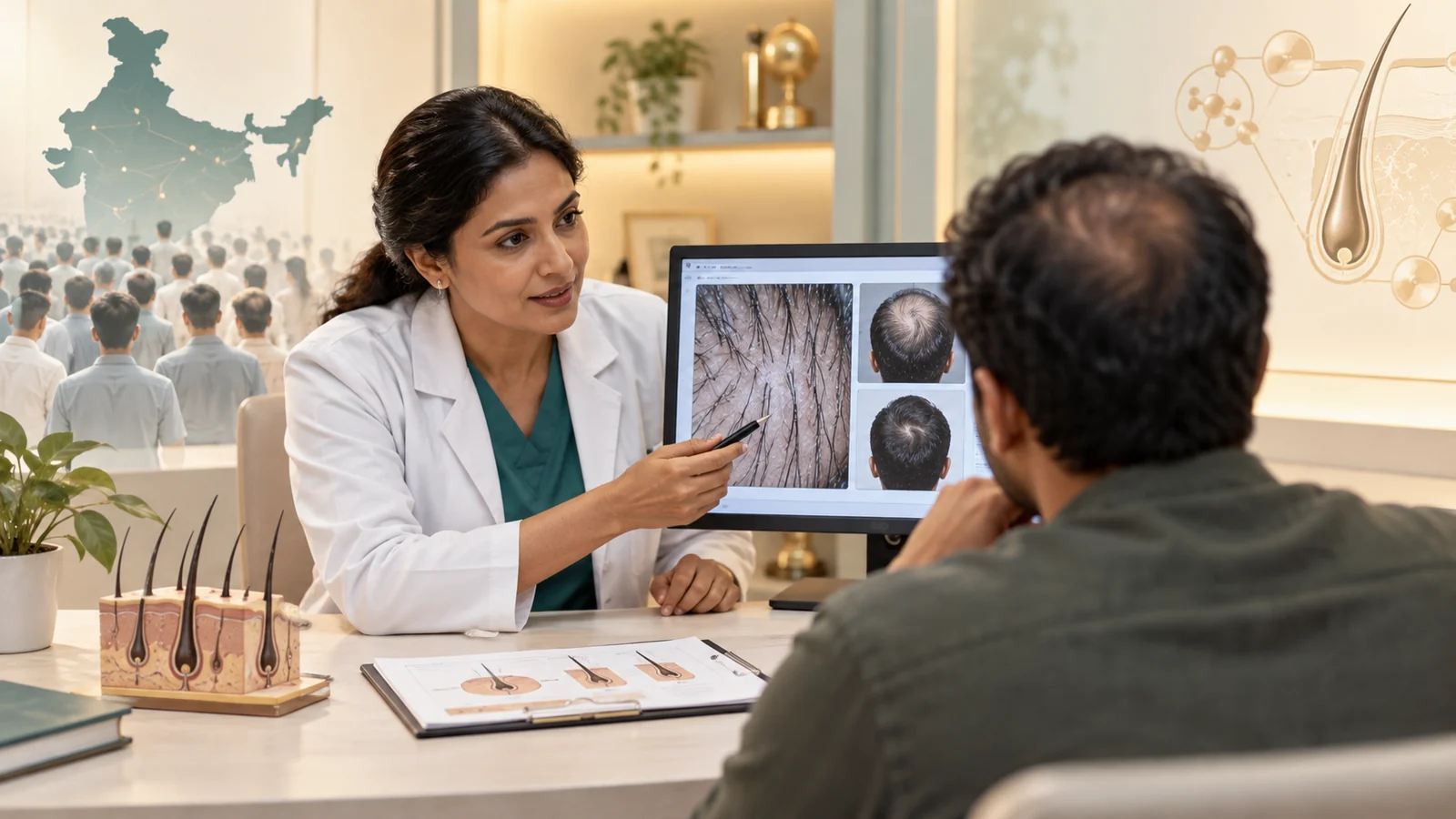
Before: Every patient at NeoGraft undergoes a full trichoscopy assessment, DHT sensitivity profile, scalp analysis, and blood panel (iron, ferritin, Vitamin D, thyroid, hormonal markers). Treatment is never one-size-fits-all.
During medical treatment: Expect 4–6 months before meaningful results are visible. Shedding in the first 4–6 weeks of starting Minoxidil is normal — it is not a sign the treatment isn’t working. It reflects follicles entering a new growth cycle.
During surgical treatment: NeoDHT and NeoPlatinum FUE are performed under local anaesthesia over 6–8 hours. Most patients return to desk work within 2–3 days. Transplanted hair sheds at weeks 3–4 (shock loss — completely normal), and new growth begins from month 3–4, with full density at 9–12 months.
After: Post-transplant DHT management protocols continue to protect both transplanted grafts and surrounding follicles. Medical stabilisation of native hair combined with surgical restoration of lost hair is the gold standard outcome.
Frequently Asked Questions
What is the best hair loss treatment in India?
The “best” treatment depends on your stage and cause. Early androgenetic alopecia responds well to medical therapy (Finasteride/Dutasteride + Minoxidil + GFC). Stages 4–7 typically require surgical restoration with NeoDHT or NeoPlatinum FUE, combined with medical stabilisation. No single treatment works for everyone — personalised assessment is essential.
Can hair loss be permanently cured in India?
Androgenetic alopecia cannot be permanently “cured” — the underlying genetic sensitivity remains. However, it can be effectively managed: medical therapy halts progression, and surgical restoration is permanent (transplanted follicles are DHT-resistant by origin). Ongoing medical maintenance prevents future native hair loss.
When should I see a hair specialist in India?
The moment you notice your hairline changing or consistent daily shedding above 100–150 hairs. The earlier treatment starts, the more follicles can be preserved. Every six months of delay in effective treatment represents additional irreversible follicle loss.
Does hard water cause permanent hair loss?
No. Hard water accelerates thinning in DHT-sensitive individuals and increases breakage, but does not directly cause follicle death. Managing water quality (filters, chelating shampoos) is a useful adjunct — but if you have androgenetic alopecia, DHT-directed treatment comes first.
Is GFC better than PRP for hair loss in India?
In clinical practice, yes — GFC delivers a higher, purer concentration of autologous growth factors than standard PRP, making it more effective for stimulating follicle activity. It’s particularly valuable for early diffuse thinning and post-transplant maintenance.
What is the cost of hair loss treatment in India?
Medical treatment (Finasteride/Dutasteride + Minoxidil) costs approximately ₹1,500–4,000 per month. GFC sessions range from ₹5,000–12,000 per session. Hair transplant cost varies by graft count and technique. For a personalised assessment and transparent pricing, book a free consultation at myneograftindia.com.
Hair loss treatment in India has never been more scientifically advanced — but the abundance of options has created an abundance of confusion. The patients who do best are those who sought proper diagnosis early, committed to a structured medical protocol, and made the surgical decision with clear eyes. If you’re ready to understand exactly what your hair loss is and what the right combination of options looks like for your specific case, I’d be glad to sit with you and walk through it.
Book a free consultation at NeoGraft Hair Clinic, Chandigarh — myneograftindia.com