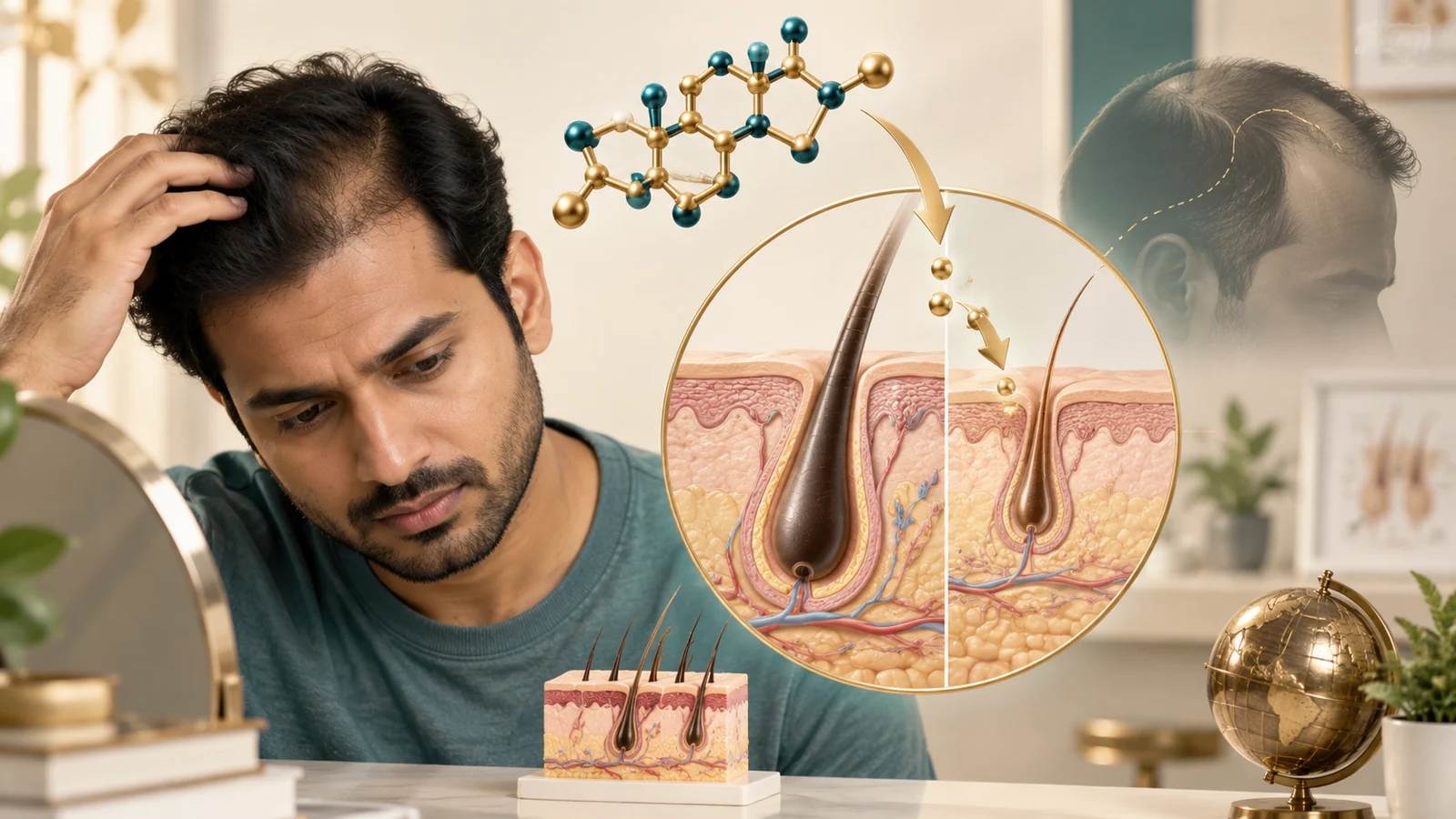
Every week in my trichology consultation room, I sit across from men in their 20s and 30s who are genuinely confused about why their hair is falling — men who eat protein, exercise, and take care of themselves. They’ve searched online, collected contradictory advice, and arrived with a jumble of half-understood theories. When I explain that a single hormone — dihydrotestosterone, or DHT — is directly responsible for the hair loss of more than 95% of men with patterned baldness, the response is usually the same: “Why am I only hearing this now?”
Male pattern baldness (androgenetic alopecia) is the most common form of hair loss in the world. In India, it affects an estimated 58% of men between the ages of 30 and 50. Studies from AIIMS and regional medical colleges consistently show that Indian men have a higher genetic sensitivity to DHT-driven follicular miniaturisation compared to several European populations — meaning the process can start earlier and progress faster. Understanding DHT is not an academic exercise. It is the single most clinically useful thing a man with hair loss can know.
The Science Behind DHT and Your Hair Follicles
Dihydrotestosterone (DHT) is produced when the enzyme 5-alpha reductase (5-AR) converts free testosterone into DHT. This conversion happens in multiple tissues — including the scalp.
Follicular miniaturisation: DHT binds to androgen receptors in the dermal papilla — the structure at the base of each follicle that controls its growth cycle. In men with a genetic predisposition, this DHT-androgen receptor binding triggers a signalling cascade that progressively shrinks the follicle. Each growth cycle (anagen phase) becomes shorter. The hair produced is finer, shorter, and less pigmented. Over time — typically 5 to 20 years — the follicle produces only a thin, colourless vellus hair, and eventually becomes dormant.
5-Alpha reductase types: There are two isoforms of the 5-AR enzyme. Type 1 predominates in sebaceous glands. Type 2 predominates in the hair follicle and prostate. This is why finasteride (a Type 2 specific inhibitor) selectively reduces scalp DHT without fully eliminating systemic DHT. Dutasteride inhibits both types and produces greater DHT suppression.
Donor dominance — the basis of transplantation: Follicles on the back and sides of the scalp (the “permanent zone”) are genetically resistant to DHT. Grafts taken from this zone, when transplanted to the frontal or crown area, retain their DHT resistance at the new location. They continue to grow for life. This is the biological foundation of all modern hair transplant surgery.
What Most People Get Wrong About DHT and Hair Loss
“High testosterone = more hair loss” — Not necessarily. DHT levels in the scalp depend on local 5-AR enzyme activity, not circulating testosterone. A man with perfectly normal testosterone and high scalp 5-AR expression can have aggressive follicular miniaturisation. Blood DHT levels correlate poorly with hair loss severity.
“Reducing DHT will restore all the hair I’ve lost.” DHT blockers halt further miniaturisation and can stimulate partial regrowth of recently miniaturised follicles. But follicles that have been dormant for years and have become fibrotic cannot be reactivated by DHT reduction alone. Early intervention matters enormously.
“Natural DHT blockers work the same as finasteride.” Finasteride has over 25 years of randomised controlled trial data showing it reduces scalp DHT by approximately 70% and maintains hair in 83–90% of treated patients. Saw palmetto and similar supplements have small, inconsistent trials. For men with progressive miniaturisation, this clinical gap is meaningful.
“It’s just genetics — nothing can be done.” The genetic component determines susceptibility, but the timeline and severity are significantly modifiable. Early medical therapy substantially alters the natural history of androgenetic alopecia. Waiting to see “how bad it gets” is the most common decision patients later regret.
What the Evidence Actually Shows
Multiple Cochrane Reviews and RCTs confirm that finasteride 1mg taken daily stabilises hair loss in approximately 83–90% of men with androgenetic alopecia over 2 years, with significant improvement in vertex density in about 65%. The medication requires consistent daily use; stopping it results in return of miniaturisation within 6–12 months.
Dutasteride 0.5mg inhibits both Type 1 and Type 2 5-alpha reductase, producing greater overall DHT suppression. A 2006 RCT in the Journal of the American Academy of Dermatology found dutasteride superior to finasteride in hair count improvement at 24 weeks. It is used off-label for androgenetic alopecia in India.
Minoxidil does not block DHT. It extends the anagen phase and works best as an adjunct to DHT-blocking therapy. Oral low-dose minoxidil (2.5–5mg) is now commonly used in Indian practice.
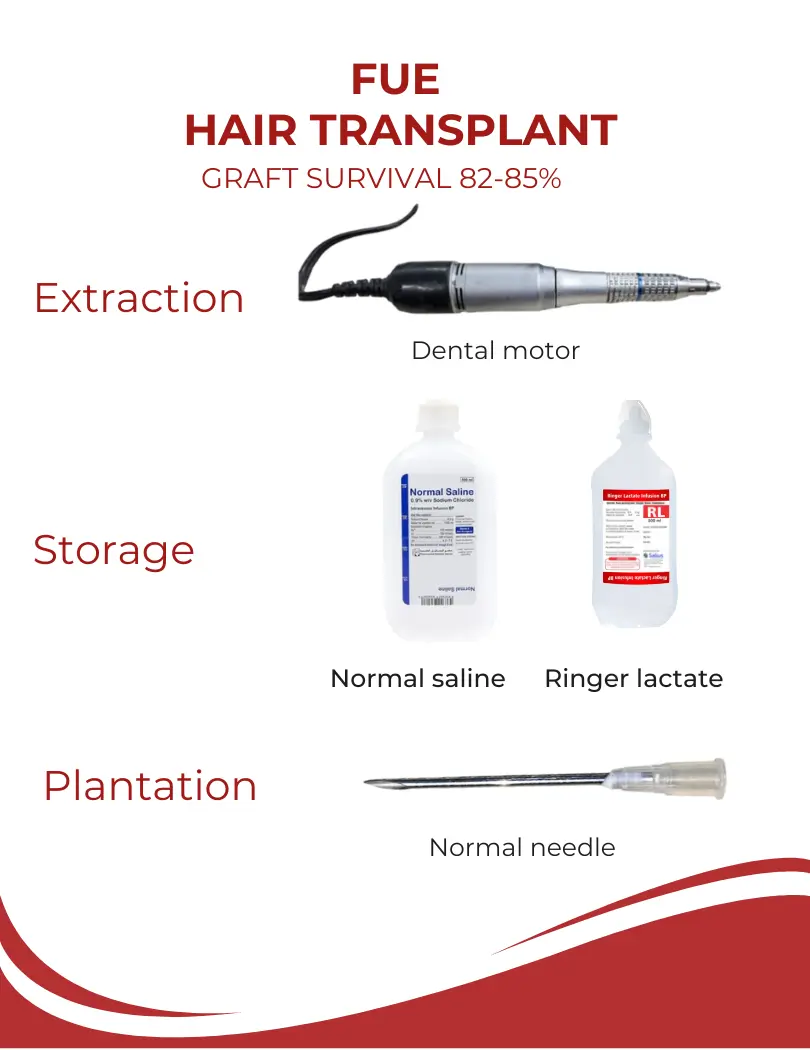
A 2020 paper in the Indian Journal of Dermatology found significant polymorphisms in the SRD5A1 and SRD5A2 genes (encoding 5-alpha reductase) in North Indian populations associated with early-onset androgenetic alopecia — a partial biological explanation for why pattern baldness often presents earlier in Indian men. Understanding the differences between FUE-based techniques is essential context for patients considering surgery.
Practical Steps: What You Can Do
1. Start with an objective trichoscopy evaluation. Self-assessing hair loss is unreliable. Trichoscopy can directly measure follicular miniaturisation — telling you what percentage of follicles are in what stage of the process.
2. Consult a physician before starting DHT-blocking medication. Finasteride and dutasteride are prescription medications with a documented side effect profile. The decision should involve a physician reviewing your complete health history.
3. Combine DHT blockade with supportive adjuncts. PRP therapy, alongside finasteride, shows additive benefit in multiple studies. Low-level laser therapy (LLLT) has supportive evidence as an adjunct.
4. Address nutritional deficiencies systematically. Iron deficiency — particularly low serum ferritin (below 70 ng/mL) — is documented to exacerbate DHT-driven hair loss. In vegetarian-dominant North Indian diets, ferritin can be significantly low even when haemoglobin is normal. A structured scalp and hair care approach complements medical therapy.
5. Start early — this is the most important step. Follicles that have been miniaturising for less than 2 years respond substantially better to medical therapy than follicles compromised for a decade.
When to See a Trichologist or Hair Surgeon
See a trichologist if you notice a gradually receding hairline or crown thinning — particularly if it began before age 35 — hair becoming progressively finer with each growth cycle, or consistent heavy daily shedding over 4+ weeks.
Consult a hair transplant surgeon if you have been on medical therapy for 12+ months without stabilisation, have established bald areas where medical regrowth is no longer realistic, or trichoscopy shows a high percentage of permanently miniaturised follicles.
Frequently Asked Questions
What is DHT and why does it cause hair loss? DHT (dihydrotestosterone) is produced from testosterone by the 5-alpha reductase enzyme. In men with genetic sensitivity, DHT binds to androgen receptors in the follicle’s dermal papilla, triggering progressive miniaturisation — each growth cycle producing thinner, shorter hair until the follicle becomes dormant.
Can I stop DHT-related hair loss naturally? Natural compounds like saw palmetto have modest evidence for mild 5-AR inhibition, but their effect size is substantially smaller than pharmaceutical options. For progressive miniaturisation, natural approaches alone are unlikely to halt the process.
Does DHT cause hair loss everywhere or only on the scalp? DHT stimulates hair growth on the beard, chest, and body. Scalp follicles in susceptible men respond to DHT with miniaturisation, while body follicles respond with growth — which explains why balding men often have robust beard and body hair.
Is DHT-related hair loss reversible? Early miniaturisation (within 2–3 years of onset) is partially reversible with DHT-blocking therapy. Once a follicle becomes fibrotic after years of miniaturisation, surgical transplantation of DHT-resistant donor follicles is the only option.
At what age does DHT-driven hair loss begin in Indian men? High-genetic-risk Indian men may show first signs as early as 18–22 years. Most cases begin between 22 and 32. By age 50, over 50% of Indian men show some degree of androgenetic alopecia.
Can women be affected by DHT-driven hair loss? Yes. Female pattern hair loss typically presents as diffuse crown thinning. PCOS-related androgen excess and post-menopausal oestrogen reduction are common triggers in Indian women.
Conclusion
DHT-driven hair loss is the dominant cause of hair loss in Indian men — starting earlier in Indian populations than in many demographics, and driven by a well-understood biological mechanism. Effective pharmaceutical options exist, the surgical solution is reliable when medicine is insufficient, and early intervention produces substantially better outcomes than delayed action.
The men who fare best are those who stop waiting for the problem to resolve on its own and seek a proper evaluation while there is still something medically meaningful to preserve.
If you have questions about your specific situation, a trichologist or hair restoration surgeon can review your case in detail.
Dr. Nav Vikram is a Hair Restoration Surgeon and Trichologist based in Chandigarh, Punjab, India. Website: https://myneograftindia.com | Phone: 9041999199
