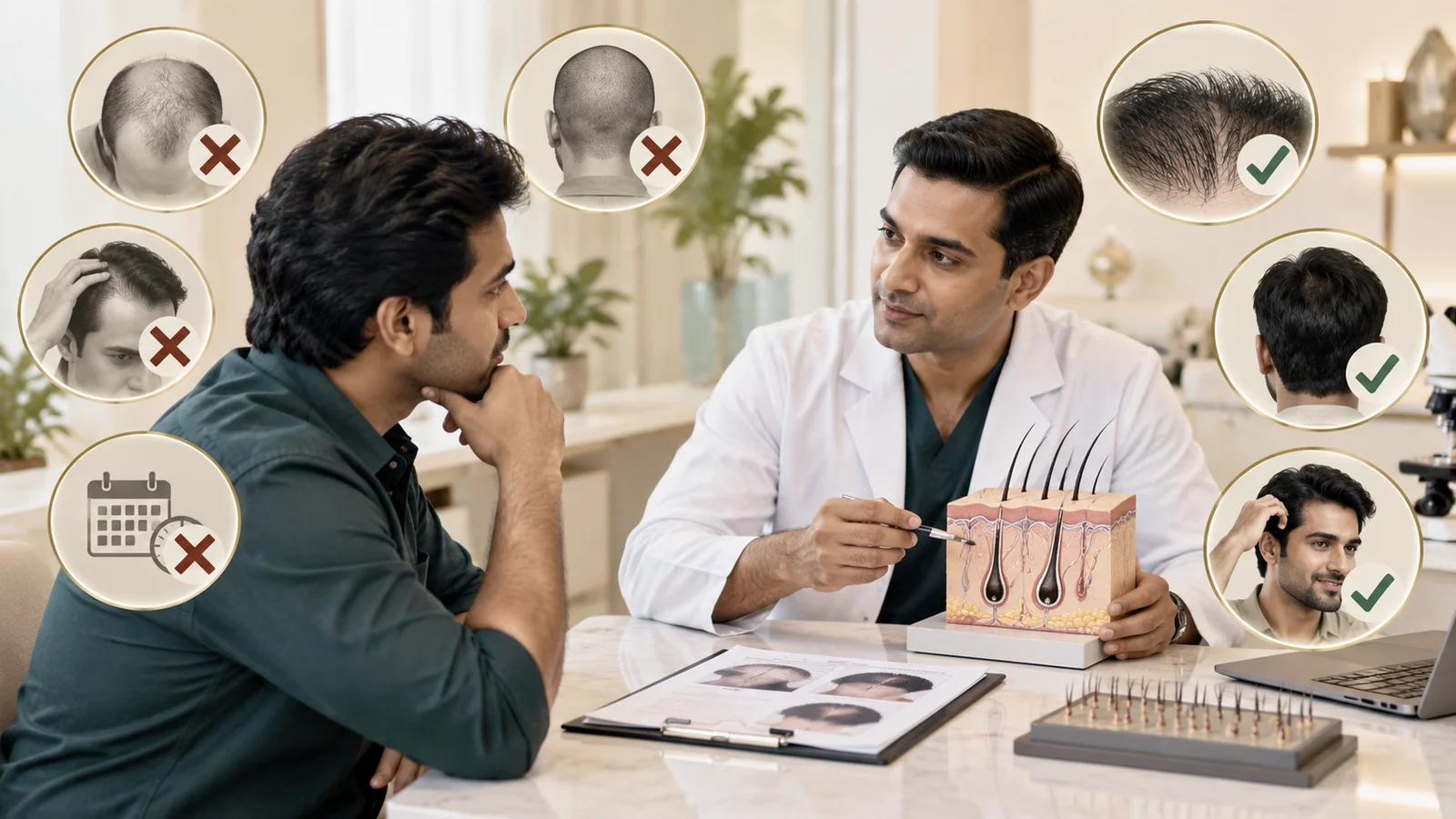
In 15 years of practice and over 10,000 procedures at NeoGraft Hair Clinic, I have had the same conversations hundreds of times. A patient sits across from me, clearly having done research – sometimes months of it – and somewhere in that research they have picked up beliefs that are simply not accurate. Some of these myths delay patients from getting the help they need. Others lead them toward decisions they later regret. I want to address them directly.
What I find particularly interesting is that many of these myths are more prevalent in India than in Western markets. Some emerge from genuine misunderstanding of the biology. Others come from anecdotal accounts shared on forums, WhatsApp groups, and YouTube comment sections. A few are actively promoted by clinics whose business model depends on patients not knowing the full picture.
Myth 1: Hair Transplant Results are Immediate
The Myth
“After the procedure, I will have a full head of hair within a few weeks.”
The Truth
After a hair transplant, the transplanted hair falls out within the first 2 to 4 weeks. This is completely normal – it is called telogen effluvium or shock loss, and it is part of the biological cycle the follicle goes through after being moved. The follicle itself is alive and intact beneath the scalp; the shaft simply sheds. New growth begins emerging at 3 to 4 months. The majority of results become visible between 9 and 12 months. Full density assessment is typically done at the 14 to 16 month mark.
Myth 2: Any FUE Clinic Will Give the Same Result
The Myth
“FUE is FUE. If the technique is the same, the result will be the same regardless of where I go.”
The Truth
FUE describes a category of extraction technique, not a standardised procedure with guaranteed outcomes. The variation in quality is enormous – and most of it comes down to who is performing the procedure and how. The angle and depth of extraction, the punch instrument size, the time grafts spend outside the body, the storage solution, the angle and density of implantation, and the hairline design are all variables that change dramatically from surgeon to surgeon. In many Indian clinics, trained technicians perform the majority of the work while the named surgeon is elsewhere. At NeoGraft, Dr. Kamboj performs every stage personally.
“The most important question a patient can ask a clinic is not which technique do you use? It is who, specifically, will be performing each stage of my procedure? The answer tells you more about your likely outcome than any technology name.”
– Dr. Nav Vikram Kamboj, Director, NeoGraft Hair Clinic, Chandigarh
Myth 3: Younger is Better – Get the Transplant as Early as Possible
The Myth
“I started losing hair at 22. I should get a hair transplant now before it gets worse.”
The Truth
Early hair transplantation in patients who are still actively losing hair is one of the most common mistakes I see. Hair loss is progressive. If you transplant hair into the hairline of a 22-year-old whose loss pattern has not stabilised, you may create an island of transplanted hair surrounded by further recession over the following years. Young patients with active hair loss benefit more from medical management – DHT-blocking agents, nutritional correction, and GFC or PRP – to stabilise the progression before any surgical intervention.
Myth 4: A Hair Transplant Stops All Future Hair Loss
The Myth
“Once I have the transplant, I do not need to worry about hair loss anymore.”
The Truth
Transplanted follicles from the permanent donor zone retain their genetic resistance to DHT and will continue to grow for life. However, native hair in non-transplanted areas continues to be affected by DHT unless medically managed. Patients who undergo a hair transplant without any accompanying medical protocol often find themselves with transplanted hair surrounded by continued thinning in adjacent areas five years later. At NeoGraft, every patient receives a long-term hair health plan – this is not optional, it is the foundational step that makes the transplant investment last.
Dr. Vikram’s Clinical Tip
I have a personal policy: I will not perform a hair transplant without a parallel DHT management plan. This is not a commercial decision – it is a clinical one. I have seen too many patients return two or three years after a technically successful procedure, distressed by continued loss in non-transplanted areas. A procedure without a maintenance plan is only half a plan. Every NeoGraft patient leaves with a complete long-term protocol, not just a surgery date. I give you my personal commitment on this.
Myth 5: Cheaper Procedures Give the Same Results
The Myth
“I found a clinic offering the same number of grafts for much less. It must be the same thing.”
The Truth
A hair transplant is not a commodity purchase. The variables that drive cost differences include: whether a surgeon or technician performs the procedure; the quality of instruments used; the graft preservation protocol; the time allocated per graft; and the post-operative support structure. A procedure achieving 60% graft survival versus 95% survival represents a profoundly different outcome – even if the quoted graft count was identical. Patients who have had poor results at lower-cost clinics and come to me for corrective work have, in almost every case, spent more in total than if they had chosen quality the first time.
Myth 6: Hair Transplants Are Only for Men
The Myth
“Hair transplants are a male thing. Women with hair loss have no options.”
The Truth
Female hair loss is clinically distinct from male pattern baldness – it tends to present as diffuse thinning rather than receding hairlines – but it is entirely addressable. Female candidates for hair transplant surgery are carefully assessed for donor zone stability. Where surgical candidacy is confirmed, outcomes are excellent. At NeoGraft, we see a meaningful proportion of female patients from across North India, many of whom have been told elsewhere that wigs are their only option.
Myth 7: Transplant Scars Are Always Visible
The Truth
Linear scarring concerns apply specifically to FUT (the older strip method). Modern FUE techniques, when performed correctly, leave only tiny circular micro-puncture marks at the donor sites – typically 0.7 to 0.9mm in diameter – that are essentially invisible once healed, even at very short hair lengths. The key qualifier is “performed correctly.” Oversized punches or excessive extraction density in one area can leave visible scarring – another reason surgeon skill matters more than technique name alone.
Myth 8: Hair Loss Is Only Genetic – Lifestyle Does Not Matter
The Truth
Genetic predisposition is the primary driver of male pattern baldness, but the rate and severity of that loss is meaningfully influenced by non-genetic factors. Iron deficiency – particularly common in Indian men on vegetarian or semi-vegetarian diets – significantly accelerates hair loss even when DHT sensitivity is moderate. Chronic stress elevates cortisol, disrupting the hair growth cycle. Thyroid dysfunction, vitamin D deficiency, and zinc insufficiency all impair follicle health independently of genetics. A thorough blood panel is part of every new patient assessment at NeoGraft. Read more in our guide on
the best age for hair transplant.
What Should Indian Patients Focus on Instead?
After debunking these myths, the question I hear is: “So what should I actually be looking for?” The answer is straightforward. Focus on who performs the procedure – not the technique name. Assess whether the clinic provides a long-term hair health plan or just a surgery date. Ask directly whether the named surgeon will be present and operating throughout. Look at results at 12 to 18 months post-procedure, not at 3 months. And be honest with yourself about your hair loss trajectory before committing to surgery.
Hair restoration is one of the most effective and evidence-based cosmetic procedures available today. When it goes well, it is genuinely life-changing. When it goes poorly – usually because of misaligned expectations or poor technique – it creates problems significantly harder to correct than the original hair loss. If you would like a direct assessment of your specific situation, NeoGraft Hair Clinic offers a free consultation by video call or in person in Chandigarh. Contact us at myneograftindia.com or call 9041999199.
Dr. Nav Vikram Kamboj
Director, NeoGraft Hair Clinic, Chandigarh10,000+ procedures over 15+ years. Specialist in NeoDHT® and NeoPlatinum FUE techniques. Serving patients from Punjab, Haryana, Himachal Pradesh, Delhi NCR, and across India.
www.myneograftindia.com | Call: 9041999199