
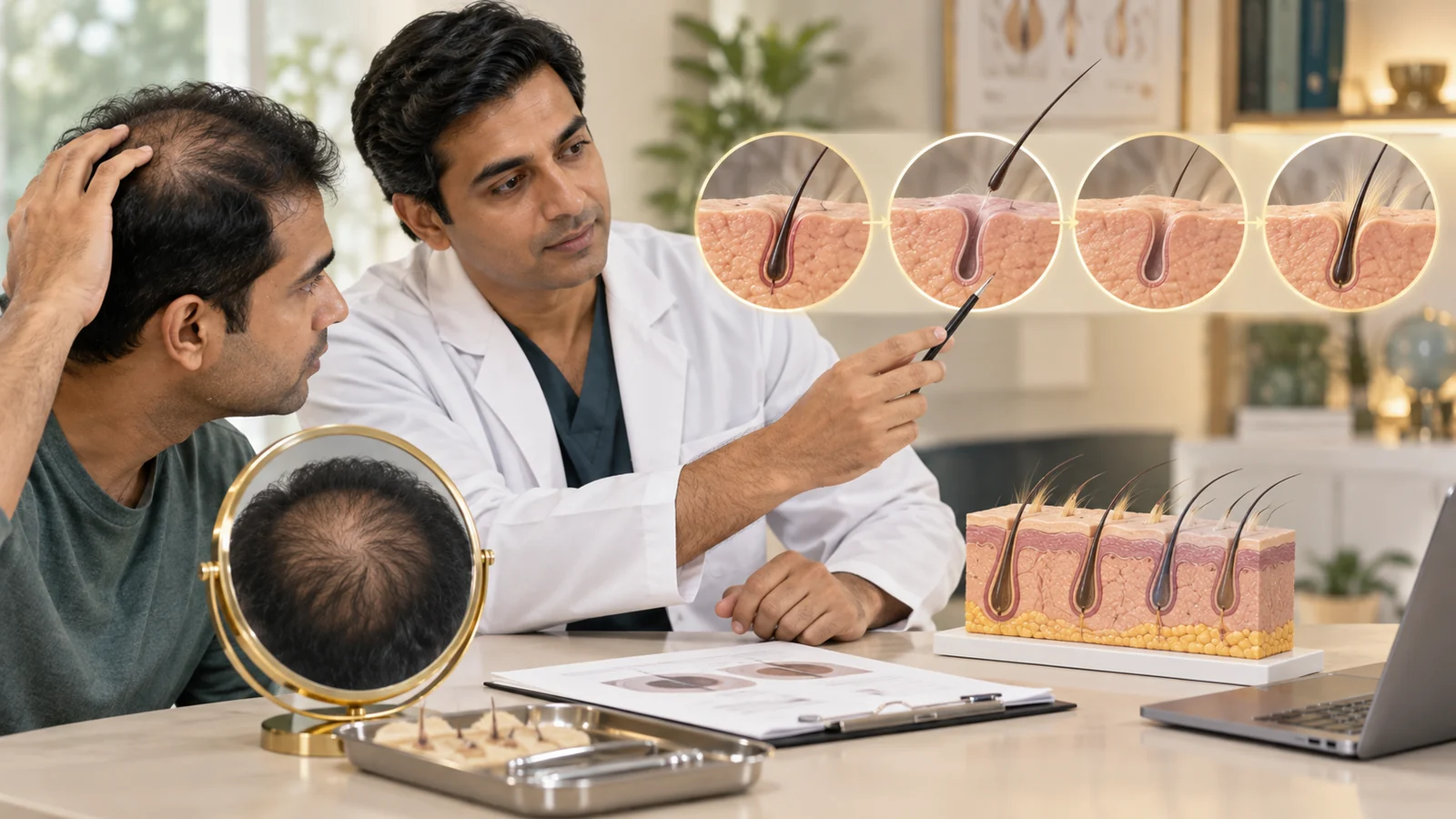
Around the third week after a hair transplant, my phone rings with the same worried voice. “Doctor, mere naye baal gir rahe hain.” The new grafts are shedding, and the patient is convinced the transplant has failed. Some have not slept properly for two nights. A few have already started searching for “hair transplant failure” online at 2 a.m.
Here is what I tell every one of them, and what I want you to understand before you ever sit in a surgeon’s chair: shedding after a hair transplant is not failure. In most cases, it is the procedure working exactly as biology says it should. But there is also a second, less-discussed kind of shedding — true shock loss of your existing hair — and that one deserves honest explanation, because clinics in India rarely bring it up before taking your money.
After more than 15 years and 10,000+ procedures at NeoGraft Hair Clinic in Chandigarh, I can tell you the difference between normal shedding, temporary shock loss, and a genuine problem. This guide covers all three.
What Is Shock Loss After a Hair Transplant?
Shock loss (medically, a form of telogen effluvium) is temporary shedding of hair triggered by the stress of surgery on the scalp. Every hair follicle cycles through growth (anagen), transition (catagen), and rest (telogen) phases. Surgical trauma — the anaesthesia, the incisions, the temporary disruption of the scalp’s micro-circulation — can push follicles prematurely into the telogen resting phase. Those hairs then shed a few weeks later.
There are two separate things patients lump together as “shock loss,” and separating them matters.
The first is shedding of the transplanted grafts themselves. Between roughly week 2 and week 8, most of the newly transplanted hairs shed their shafts. This looks alarming, but the follicle — the living root beneath the skin — stays in place. The hair shaft is simply released as the follicle resets its cycle. Regrowth from these same follicles begins around month 3 to 4.
The second is shock loss of your existing, native hair — the hair you already had around the transplanted zone, or occasionally in the donor area at the back of the head. This is true shock loss. It affects a minority of patients, is usually temporary, and typically recovers within 3 to 6 months — but hair that was already weak and miniaturised by DHT may not always return fully. That last sentence is the honest part many clinics skip.
The Shedding Timeline: What Happens Month by Month
Every scalp is different, but after thousands of cases I see the same broad pattern repeat. Use this as your reference before you panic:
| Period | What you may notice | Is it normal? |
|---|---|---|
| Week 1–2 | Scabs settle; transplanted hairs intact | Normal |
| Week 2–8 | Transplanted hair shafts shed; area may look thinner than before | Normal — follicles remain |
| Month 1–3 | Possible shock loss of native hair near the transplant zone | Common, usually temporary |
| Month 3–4 | First new growth appears — fine, soft, sometimes uneven | Normal |
| Month 5–8 | Visible thickening; texture matures | Normal |
| Month 9–12+ | Final density develops | Normal |
If you compare this with our detailed hair transplant recovery timeline, you will notice the shedding phase sits exactly in the window when patients feel most vulnerable — after the excitement of surgery, before the reward of regrowth. Knowing the timeline in advance is the single best protection against panic.
Why Native Hair Shock Loss Happens — and the DHT Connection
Here is the part I insist every Chandigarh and out-station patient understands during consultation. Native hair around a transplant zone is often already under attack from DHT (dihydrotestosterone), the hormone that drives male pattern baldness. A follicle that is miniaturised — producing thinner, shorter hair each cycle — is fragile. Surgical stress can tip it into shedding, and a severely miniaturised follicle may not have another strong cycle left in it.
This is precisely why at NeoGraft we built the NeoDHT® protocol around the hormone itself, not just the surgery. Managing DHT medically before and after the procedure does two things: it stabilises the native hair so it is more resilient to surgical stress, and it protects your long-term result so you are not transplanting new hair into a field that keeps thinning around it. A transplant without a DHT plan is only half a treatment — I have said this for years, and shock loss is one of the clearest places you see why.
How We Minimise Shock Loss at NeoGraft Chandigarh
I cannot promise any patient zero shock loss — no honest surgeon can. What I can tell you is which factors are in the surgeon’s control, because this is exactly what you should ask any clinic you are considering.
Dense-packing discipline matters. Implanting between existing hairs requires precise angles and spacing; careless technique physically damages neighbouring follicles — that is avoidable shock loss caused by the operator, not biology. Anaesthesia volume and technique matter, as does gentle graft handling and minimal time outside the body. Pre-operative assessment matters most of all: if your existing hair is actively shedding or heavily miniaturised, the responsible answer is sometimes to stabilise it medically for a few months before surgery, not to operate on the first visit. A clinic that books every walk-in for surgery the same week is telling you something about its priorities.
Nutrition and aftercare play a supporting role too — graft survival and recovery quality are influenced by what you eat in the first month. I have written a complete guide on the hair transplant recovery diet for Indian patients, and I recommend reading it alongside this one.
When Shedding Is NOT Normal: Red Flags
Most shedding calls I receive end with reassurance. A few do not. Contact your surgeon promptly if you notice shedding accompanied by pus, spreading redness, or fever — these suggest infection, not shock loss. Shedding that starts very late (many months after surgery) with continued thinning is more likely progressive hair loss than shock loss, and it means your DHT management needs review. And if the donor area at the back shows patchy, well-defined bald spots rather than diffuse mild thinning, that needs examination — occasionally an unrelated condition such as alopecia areata surfaces after surgery and needs its own treatment.
The difference between these situations and normal shedding is impossible to judge from a WhatsApp photo alone, which is why every NeoGraft patient has direct follow-up access to my team through the full first year.
Frequently Asked Questions
Does shock loss mean my hair transplant has failed?
No. Shedding of transplanted hair shafts between weeks 2 and 8 is an expected part of the follicle’s cycle — the roots remain and regrow from month 3–4. True failure shows up much later, as absent regrowth by month 6–9, and is a different problem with different causes.
How long does shock loss last?
Native-hair shock loss typically recovers within 3 to 6 months as follicles re-enter the growth phase. Transplanted-hair shedding resolves as new growth appears from month 3 onward, with density building through month 12.
Can shock loss happen in the donor area?
Yes, occasionally — usually mild, diffuse, and temporary, caused by anaesthesia and extraction stress. Careful extraction spacing keeps donor shock loss uncommon; patchy or persistent donor loss should be examined.
Can I prevent shock loss completely?
No clinic can guarantee that, and you should be cautious of any that does. You can reduce the risk meaningfully: choose an experienced surgical team, stabilise your existing hair with a proper DHT-management plan such as NeoDHT®, and follow your aftercare and nutrition protocol seriously.
Should I stop finasteride or minoxidil after my transplant?
Do not stop anything without speaking to your surgeon. In most of my patients, continuing prescribed DHT management protects the native hair through the shedding window. Stopping abruptly around surgery is one of the commoner avoidable causes of prolonged shedding I see in patients who come to me after procedures elsewhere.
The Honest Summary
Shedding after a hair transplant frightens patients because nobody prepared them for it. Now you are prepared: transplanted hairs shed and return; native hair can experience temporary shock loss; DHT management before and after surgery is your best protection; and a small set of red flags separate normal biology from a real problem. If you are three weeks post-surgery and watching hairs on your pillow, breathe — and if you are still choosing a clinic, ask them how they minimise shock loss. Their answer will tell you a great deal.
If you would like your scalp, your existing hair, and your DHT risk assessed honestly before you commit to anything, come and see us.
Book your free consultation — NeoGraft Hair Clinic — SCO 3009-3010, Sector 22D, Chandigarh — myneograftindia.com
— Dr. Nav Vikram | NeoGraft Hair Clinic, Chandigarh