
Every week in my consultation room in Chandigarh, after we have discussed grafts, hairlines and costs, a patient leans forward and asks the question that was really on his mind the whole time: “Doctor, dard kitna hoga?” How much will it hurt?
It is an honest question, and it deserves an honest answer — not a marketing slogan. If you search for a painless hair transplant in India, you will find clinics promising “100% painless” procedures as if pain were a switch they simply turned off. As a surgeon who has performed hair restoration for over 15 years at NeoGraft Hair Clinic, let me tell you what “painless” actually means in real clinical practice — where the discomfort comes from, how a well-run clinic reduces it to almost nothing, and which claims should make you cautious.
The Honest Answer: Nearly Painless Is Real. “Zero Pain” Is Marketing.
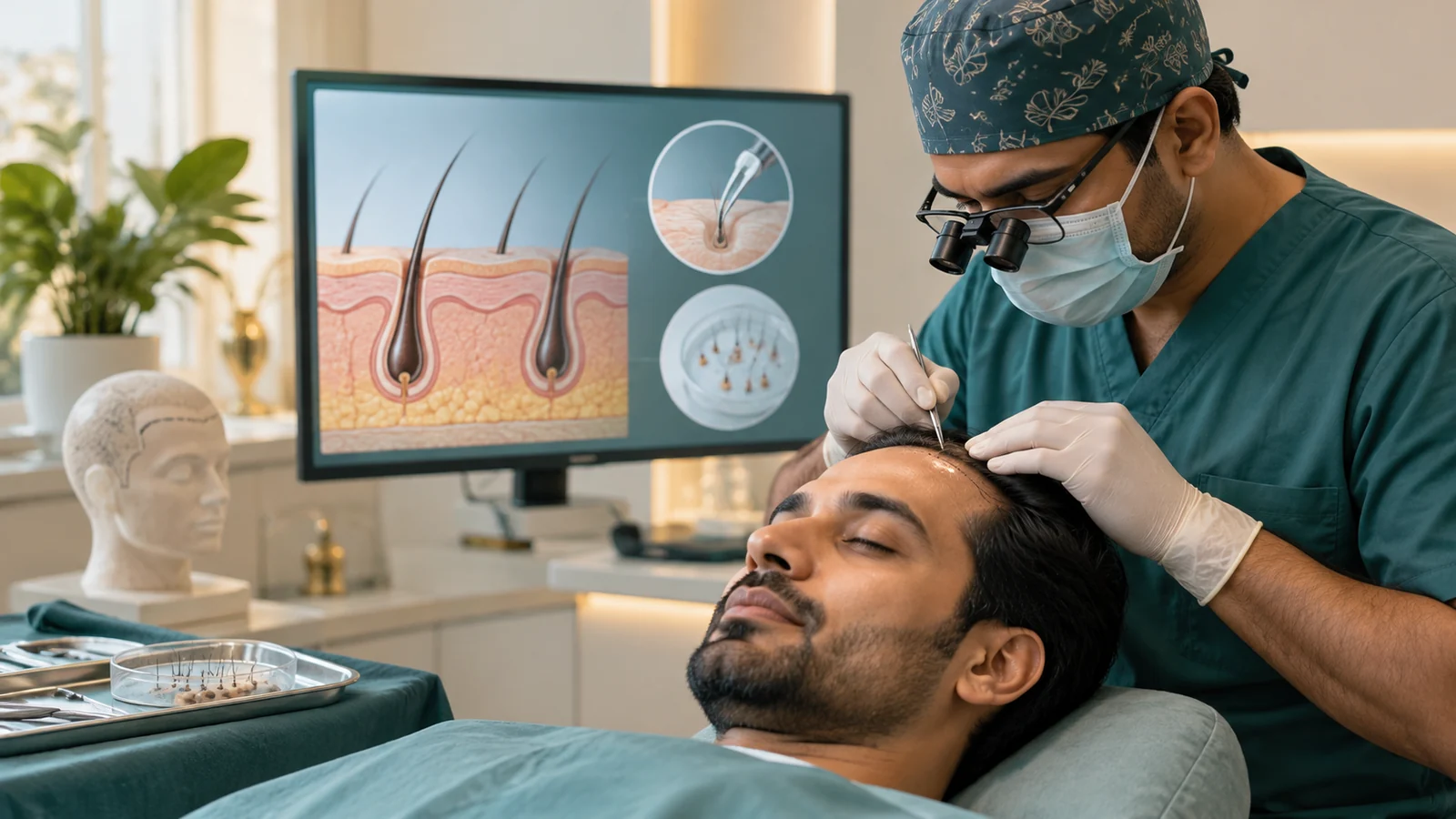
A modern FUE hair transplant is performed entirely under local anaesthesia. Once the scalp is anaesthetised, you feel pressure and movement, but not pain. Most of my patients watch films, scroll their phones, chat with my team, and several have fallen asleep on the table during long sessions. In that sense, yes — the procedure itself is effectively painless.
But here is what the “100% painless” advertisements do not tell you: the anaesthesia itself has to be delivered first, and that involves a few injections. However skilled the surgeon, those first moments involve some discomfort — most patients compare it to a dental injection, uncomfortable for a few seconds rather than genuinely painful. A clinic that is honest about those few seconds is a clinic you can trust with the next eight hours.
Where the Discomfort Actually Comes From — and How We Minimise Each Step
Pain in a hair transplant is not one thing. It has three distinct sources, and each one has a specific solution. This is exactly how we approach comfort in the NeoDHT® protocol at NeoGraft Hair Clinic:
| Source of discomfort | When it happens | How we minimise it |
|---|---|---|
| Anaesthesia injections | First 5–10 minutes | Very fine needles, slow buffered infiltration, vibration analgesia to distract nerve signals, and numbing the first entry point before wider infiltration |
| The procedure itself | Extraction & implantation hours | Complete local anaesthesia — you feel pressure, not pain; comfort checks throughout, with top-up anaesthesia the moment sensation returns |
| Post-operative soreness | First 2–3 nights | Mild donor-area tightness managed with simple prescribed analgesics; FUE leaves no linear wound, so recovery discomfort is limited |
Notice something important: the part patients fear most — the long hours of the procedure — is the part that hurts the least. The part clinics advertise as “zero pain” — the anaesthesia — is the only part with brief, real discomfort. Good technique shrinks it; nothing honest erases it completely.
Why FUE Made the “Painless” Conversation Possible
Older strip surgery (FUT) removed a band of scalp from the donor area and stitched it closed. That linear wound was the main reason hair transplants earned a painful reputation — the aching, the tightness, the sutures, the weeks of care.
Modern FUE — the foundation of our NeoDHT® technique — extracts follicles individually through tiny punches, leaving no linear incision and requiring no stitches. Most of my FUE patients describe the days after surgery as “itchy and tight” rather than painful, and many need simple painkillers for only a night or two. Recovery comfort also depends on what you do at home in those first weeks — I have written a full guide on what to eat in the first four weeks after a hair transplant to support graft survival and healing.
Sedation, Needle-Free Devices and “Sleep Transplants”: What Is Worth It?
You may have seen clinics advertise needle-free jet anaesthesia or full sedation “sleep” transplants. A brief, honest view from the surgical side:
Needle-free jet injectors push anaesthetic through the skin under pressure. They reduce needle anxiety, but they do not eliminate sensation — the jet itself produces a snapping sting — and they still need to be followed by conventional infiltration for surgical-depth anaesthesia. Useful for very needle-phobic patients; not magic.
Oral anxiolytics (a mild relaxant tablet before the anaesthesia stage) genuinely help anxious patients, and we use them selectively after assessing your medical history. Deep sedation or general anaesthesia, on the other hand, adds real anaesthetic risk to what is otherwise a very safe local procedure — for a benefit measured in a few seconds of comfort. I do not recommend it for routine hair transplants, and you should ask hard questions of any clinic that pushes it as a default.
Red Flags: When “100% Painless” Marketing Should Worry You
The phrase “painless hair transplant” is not a technique. It is a description of how well a clinic executes anaesthesia and surgical discipline. So when you compare clinics in India, treat the pain conversation as a window into their honesty. Be cautious when a clinic promises absolute zero pain but cannot explain how they achieve comfort at each stage; when the person answering your medical questions is a counsellor or salesperson rather than the operating doctor; or when “painless” is bundled with a price that seems too good — comfort protocols, fine instruments and unhurried anaesthesia take time, and time is exactly what cut-price clinics cut first. I have explained this economics problem in detail in my guide to what you are really paying for per graft in India.
A truthful clinic will tell you: a few seconds of dental-injection-level discomfort, then hours of numb, comfortable surgery, then two or three mildly sore nights. If someone promises better than biology allows, ask yourself what else they are overpromising — graft survival numbers, hairline design, who actually performs your surgery.
Frequently Asked Questions
Is a hair transplant painful in India?
The procedure itself is performed under local anaesthesia and is effectively painless — patients feel pressure and movement, not pain. The only genuinely uncomfortable moments are the initial anaesthetic injections, which most patients compare to dental injections lasting a few seconds. Post-operative soreness is mild and typically settles within two to three days after FUE.
Which hair transplant technique is the least painful?
FUE-based techniques — including our NeoDHT® protocol — involve significantly less post-operative discomfort than older strip (FUT) surgery, because there is no linear wound and no stitches. During the procedure itself, all techniques are equally comfortable once anaesthesia is properly delivered; the difference lies in the recovery days.
Will I be awake during the transplant?
Yes — and that is a good thing. You remain comfortably awake under local anaesthesia, able to take breaks, eat lunch, watch a film or talk to the team. Staying awake avoids the added risks of general anaesthesia and lets you give feedback during hairline placement. Anxious patients can be given a mild relaxant tablet after medical assessment.
How long does pain last after a hair transplant?
After FUE, most patients describe tightness, mild soreness or itching rather than true pain, mainly in the donor area for the first two or three nights. Simple prescribed painkillers are usually needed only briefly. If severe or worsening pain occurs after the first week, contact your surgeon — that is not normal and needs review.
Does a painless hair transplant cost more in India?
Comfort is not a paid add-on; it is a sign of surgical discipline. Fine instruments, buffered anaesthesia and an unhurried technique take more time per patient, which is partly why serious clinics do not compete at rock-bottom per-graft prices. Be sceptical of clinics that advertise both “cheapest” and “100% painless” — those two claims rarely live together honestly.
Come and Ask Me the Pain Question Yourself
Fear of pain stops more men from fixing their hair loss than cost does. If that fear has been holding you back, come and sit with me — I will show you the instruments, explain every step of the NeoDHT® comfort protocol, and you can speak to patients who have been through it. No pressure, no slogans, just an honest conversation.
Book your free consultation — NeoGraft Hair Clinic — SCO 3009-3010, Sector 22D, Chandigarh — myneograftindia.com
— Dr. Nav Vikram | NeoGraft Hair Clinic, Chandigarh