
⚠️ SURGEON’S GUIDE — TECHNIQUE COMPARISON, NOT MARKETING
FUE, DHI, DHT, sapphire, robotic — which one is right for you, what does each really cost per graft, and which protects the grafts you are paying for? An honest, technique-by-technique breakdown from the operating chair.
By Dr. Nav Vikram Kamboj | NeoGraft Hair Clinic, Chandigarh | 2026
Quick Facts — Technique Comparison
3 Techniques — FUE, DHI & DHT
Cost Per Graft (India) — ₹25 to ₹130
Graft Out-of-Body Time — Minutes vs Hours
The Real Deciding Factor — The Surgeon, Not the Acronym
All figures are indicative 2026 ranges; final pricing depends on graft count, baldness grade, and surgeon involvement.
Why This Choice Confuses Almost Every Patient
Most technique comparisons live in marketing — glossy claims without any clinical framework. That is not what this is.
Every week in my Chandigarh clinic, I meet patients who have spent hours online comparing techniques and arrive more confused than when they started. The alphabet soup of hair-restoration marketing has made it genuinely difficult for an Indian patient to make an informed decision. So let me simplify it, surgeon to patient — no inflated statistics, no scare tactics.
First, Understand What Actually Determines Your Result
The single biggest factor in graft survival is how long the graft stays outside your body and how it is handled during that time. A hair graft is living tissue. From the moment it is extracted, it is deprived of blood supply, and the longer it waits in a dish — even chilled — the more its viability drops. Every technique below ultimately comes back to this one biological reality.
✦ FUE — The Foundation Technique
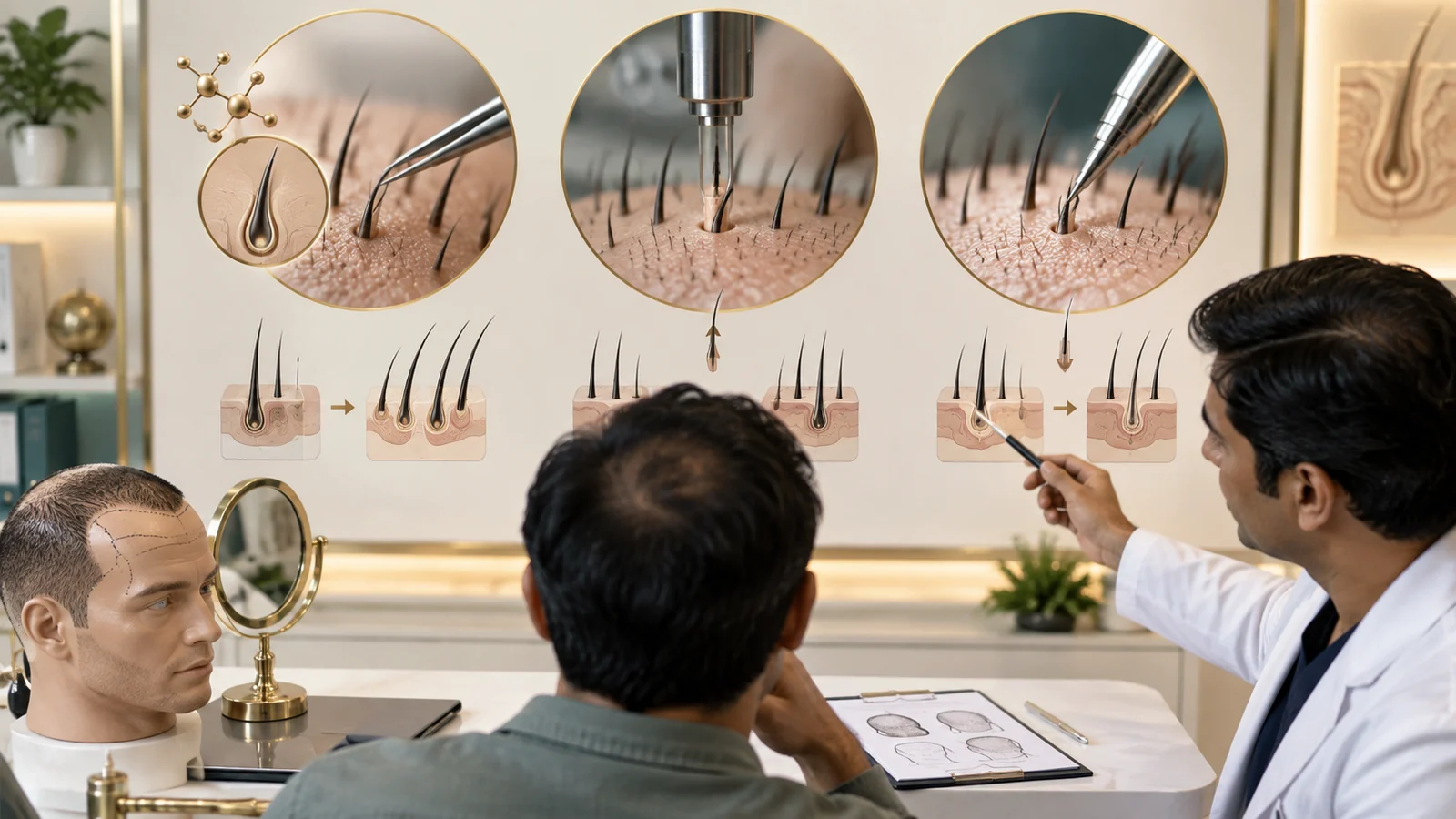
In FUE, individual follicular units are extracted with a 0.7–1.0 mm micro-punch and stored in holding solution. The surgeon creates recipient slits, and grafts are then placed with forceps — typically by technicians. Its strengths are real: no linear scar, faster donor healing, and wide availability that keeps prices competitive.
Clinical observation: The standard workflow is extract-all → slit → implant. First-extracted grafts can wait 2–6 hours in a large session, and forceps handling risks crushing the bulb. This is where results quietly get compromised — especially at high-volume, technician-driven clinics.
✦ DHI — Implanter Pen Precision
DHI uses the same FUE extraction, but implantation is done with a Choi implanter pen that creates the site and places the graft in one motion — no pre-made slits, no forceps. Patients like it for the excellent control over angle, depth, and direction (critical for a natural hairline), the option of an unshaven procedure, and reduced handling.
Clinical observation: Sessions run slower, DHI typically costs ₹40–₹120 per graft versus ₹25–₹80 for FUE, and most DHI clinics still extract-first-implant-later — so out-of-body time is reduced, not eliminated.
✦ DHT — Extraction and Implantation, Simultaneously
DHT — Direct Hair Transplantation — is the technique I have built my practice around. Here, extraction and implantation happen in parallel: as grafts come out of the donor area, they go into freshly made recipient sites within minutes, not hours. Think of a relay running continuously — extract a small batch, implant it immediately, repeat.
Clinical observation: Published storage literature consistently shows viability declines with time outside the body. Collapsing that window to minutes protects survival, and implanting into freshly made sites supports anchoring. DHT demands a hands-on surgeon and a tightly coordinated team — it cannot be rushed into factory-style mega-sessions, which is exactly why few Indian clinics offer true DHT.
📋 DHT vs FUE vs DHI in India (2026)
| Parameter | FUE | DHI | DHT |
|---|---|---|---|
| Implantation | Forceps into pre-made slits | Choi implanter pen | Immediate, minimal delay |
| Graft out-of-body time | 2–6 hours | 1–4 hours | Minutes |
| Graft handling risk | Moderate (forceps) | Low | Low |
| Hairline angle control | Good (surgeon-dependent) | Very good | Very good |
| Downtime | 5–7 days | 5–7 days | 5–7 days |
| Cost per graft (India) | ₹25–₹80 | ₹40–₹120 | ₹50–₹130 |
| Availability in India | Very wide | Wide in metros | Limited, select clinics |
Which Technique Should You Choose?
Choose FUE if budget is your main constraint — but choose the clinic carefully. The risk is not the technique, it is factory-style execution. Choose DHI if you need an unshaven procedure or are restoring a hairline or temple points where angle control is everything, with a modest graft requirement. Choose DHT if graft survival is your top priority — which, frankly, it should be. You are paying per graft; you want the maximum number of those grafts to actually grow. DHT particularly suits limited donor reserves, repair cases, and higher Norwood grades where wastage is unaffordable.
If you remember one thing: the surgeon matters more than the acronym. Ask who extracts, who implants, how long grafts stay outside the body, and how many procedures the clinic runs per day. The answers reveal more than any brochure.
The NeoDHT® Difference — How We Refined DHT at NeoGraft Chandigarh
Over years of performing DHT, my team and I standardised the refinements that consistently improved our outcomes into our exclusive NeoDHT® protocol. It is not a different surgery — it is DHT executed with tighter discipline.
| Factor | Standard DHT | NeoDHT® at NeoGraft |
|---|---|---|
| Graft waiting time | Minutes | Batch-synchronised — no graft waits beyond a few minutes |
| Holding solution | Standard chilled | Chilled, biotin-enriched even for brief windows |
| Hairline & frontal zone | Team-dependent | Surgeon-performed in every case |
| Donor safety | Surgeon judgement | Density mapping before extraction |
| Follow-up | Variable | Structured 12-month photographic review |
What Indian Patients Should Take Away
Graft survival is the number that matters most. You are paying per graft — the technique that keeps the most of them alive gives you the best value, not just the lowest sticker price.
The workflow tells the truth. Extract-first-implant-later means longer out-of-body time. Simultaneous extraction and implantation is the biological advantage behind DHT.
A cheaper quote can cost more. Factory-style, technician-driven sessions can compromise results regardless of the acronym on the brochure.
The surgeon is the variable, not the machine. Who performs your hairline and how the clinic manages graft time determines your outcome more than the technique’s name.
Why Choose NeoGraft India?
10,000+ Successful Cases
99–100% Graft Survival Rate
NeoDHT® Exclusive Technique
Dr. Nav Vikram Specialist Surgeon
Frequently Asked Questions
What is a DHT hair transplant?
DHT (Direct Hair Transplantation) implants grafts almost immediately after extraction, keeping out-of-body time to minutes instead of hours — protecting viability and supporting more consistent growth.
Is DHT better than FUE?
DHT uses the same extraction as FUE but eliminates the long waiting period of the conventional workflow. Because survival declines with time outside the body, DHT offers a biological advantage — when performed by an experienced, hands-on team.
What is the difference between DHI and DHT?
DHI refers to implantation with a Choi pen (angle and depth control). DHT refers to workflow timing — implanting within minutes of extraction. A clinic can combine both principles, which is the basis of our NeoDHT® protocol.
How much does a DHT hair transplant cost in India?
In 2026, roughly ₹50–₹130 per graft depending on city, graft count, and surgeon involvement. A 3,000-graft procedure may range from about ₹1.5 lakh to ₹4 lakh. Always confirm what the quote includes.
Is DHT painful, and what is the downtime?
It is performed under local anaesthesia, so you feel pressure but not pain. Most patients resume desk work in 2–3 days, with scabs clearing in about 7–10 days.
Conclusion
Choosing a technique is really choosing a philosophy of graft care. FUE, DHI, and DHT are not rivals so much as points on a spectrum of how carefully your living grafts are handled between the donor area and their new home. The honest clinical answer is that the acronym matters far less than the hands performing it and the time your grafts spend outside your body.
If you would like an examination-based opinion on whether FUE, DHI, or our NeoDHT® protocol suits your pattern of hair loss, donor reserve, and budget, consult me personally. We regularly treat patients travelling from Delhi, Punjab, Haryana, Himachal, and across India, and video consultations are available for a preliminary assessment. That conversation, at NeoGraft, is free.
Book your free consultation — NeoGraft Hair Clinic — SCO 3009-3010, Sector 22D, Chandigarh — myneograftindia.com
— Dr. Nav Vikram | NeoGraft Hair Clinic, Chandigarh