
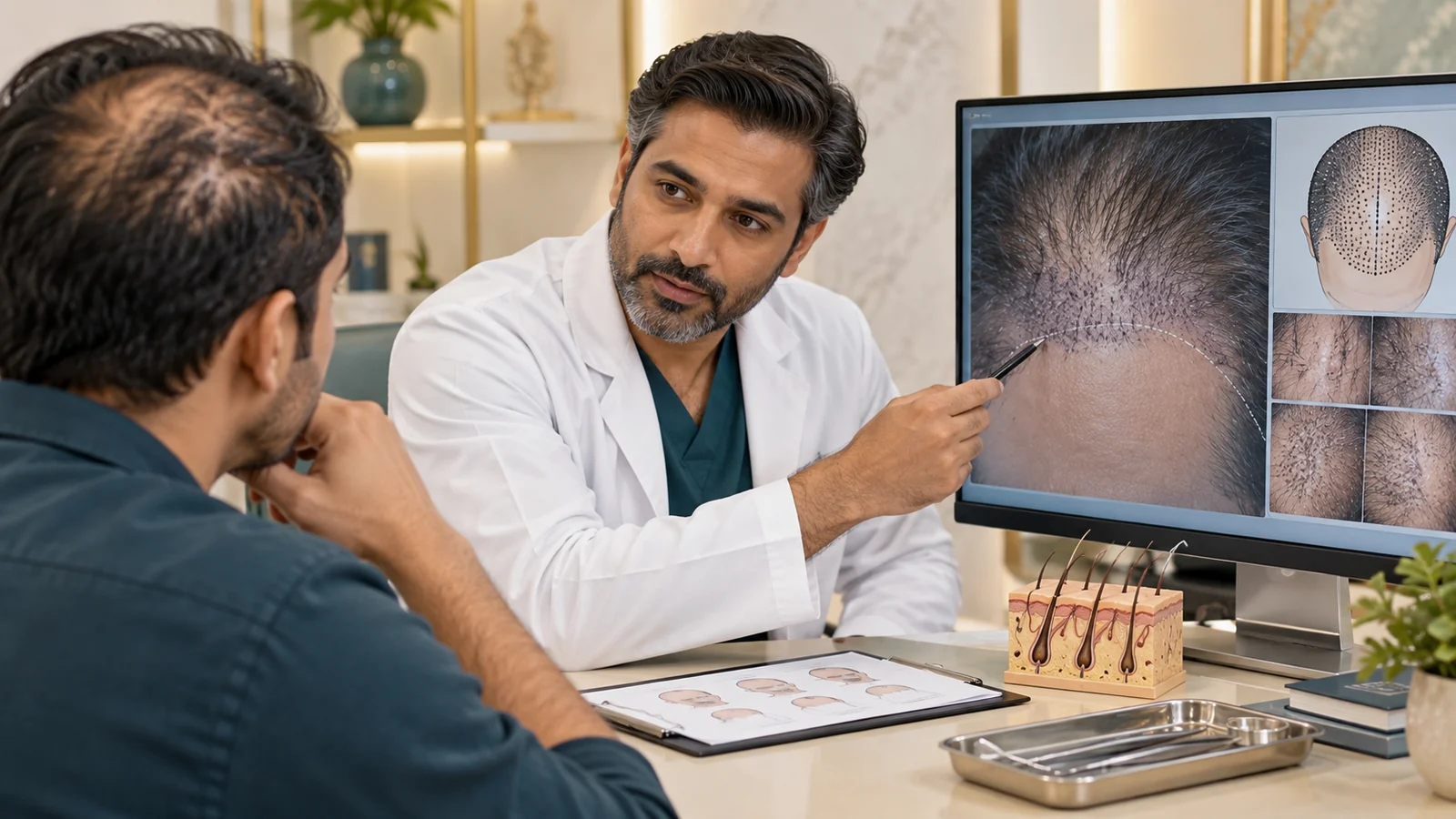
Every month, men travel to my clinic in Chandigarh from Delhi, Ludhiana, Jaipur, even Dubai — not for a first hair transplant, but to ask whether a bad one can be fixed. They sit down, take off their cap, and say some version of the same sentence: “Doctor, I already spent money once. Tell me honestly if this can be repaired.”
I want to answer that question properly here, because there is very little honest information about hair transplant repair in India. Clinics advertise transplants everywhere; almost nobody talks about what happens when one goes wrong. The short answer: most failed transplants can be meaningfully improved, some can be fully corrected, and a few should not be touched again for at least a year. Knowing which category you fall into is the entire game.
Why Hair Transplants Fail in India More Often Than They Should
A hair transplant is a surgical procedure, yet in many Indian cities it is sold like a salon service. When I examine repair patients, the story behind the failure is usually one of these:
The surgeon never touched the patient. Technician-run procedures — where the doctor appears for ten minutes and unsupervised staff do the extraction and implantation — remain the single biggest cause of the failed results I see. Graft handling, depth and angle control all suffer.
The donor area was over-harvested. Some clinics extract 4,000–5,000 grafts in one sitting from a donor area that could safely give 2,500. The back of the head is left visibly patchy, and — this is the painful part — the patient has lost donor reserves he will need for the repair.
The hairline was designed wrong. Too low, too straight, too dense at the front. A 25-year-old’s hairline on a 45-year-old face never looks natural, and as native hair behind it recedes, the transplanted strip stands alone like an island.
Nobody managed the DHT problem. Grafts were implanted, but the hormonal cause of the hair loss was ignored. The transplanted hair survived; the native hair around it kept falling. Two years later the result looks worse than before surgery. This is exactly why we built the NeoDHT® protocol at NeoGraft — a transplant that does not address DHT is a temporary patch, not a result.
The Five Problems I See Most in Repair Consultations
Almost every repair case that walks into my clinic involves one or more of these five patterns. First, the pluggy or “doll’s hair” look — grafts placed in visible rows or clusters, usually because multi-follicle grafts were used at the hairline where only single follicles belong. Second, wrong direction and angle — hair growing straight out of the scalp or against the natural flow, which no styling can hide. Third, low density — a transplant that technically “grew” but delivered 40–50% survival, leaving a see-through result. Fourth, a scarred, moth-eaten donor area from aggressive extraction. And fifth, the island effect — a transplanted zone surrounded by ongoing native loss that was never medically managed.
How a Hair Transplant Repair Actually Works
Repair is more demanding than a first transplant, and the sequence matters. At NeoGraft Hair Clinic, a repair case moves through four stages.
Stage one: the donor audit. Before I promise anything, I examine the donor area under magnification and count what remains — safe-zone density, scarring, beard and body hair as backup sources. Your donor reserve is a fixed bank account; the first clinic already made a withdrawal, and my job is to budget what is left honestly. If a clinic quotes you a repair without a donor examination, walk out.
Stage two: removing what cannot stay. Badly placed hairline grafts can often be extracted one by one with fine FUE punches — carefully, so the follicles survive — and re-implanted at correct angles further back. Not every bad graft needs removal; camouflage in front of them is sometimes the smarter, donor-saving choice.
Stage three: rebuilding. New grafts are placed to correct the hairline design, add density and restore natural direction. In repair work, implantation angle control is everything — this is where the nanomotor precision we use in our NeoPlatinum FUE protocol earns its keep, because we are working between existing grafts and scar tissue.
Stage four: protecting the investment. The repair only holds if native hair stops disappearing behind it. Every repair patient at our clinic goes onto a supervised NeoDHT® medical plan, because repairing a transplant while ignoring DHT is how the first failure happened.
What Repair Costs in India — An Honest Framework
I will not quote a single number here, because repair pricing depends on what needs to be done — and anyone who quotes you a flat price before examining your scalp is guessing. What I can give you is the honest framework.
| Repair scenario | Typical approach | Sittings |
|---|---|---|
| Low density, good donor left | Density fill with FUE | 1 |
| Pluggy hairline | Graft extraction + redesign | 1–2 |
| Over-harvested donor | Beard/body hair FUE, staged | 2+ |
| Island effect / ongoing loss | Medical stabilisation first, then fill | 1 (after 6–12 months) |
Repair grafts cost more per graft than first-time grafts — the work is slower and riskier, and that is true at any honest clinic. Before comparing quotes, read my detailed breakdown of what you are really paying for per graft in India, because the cheap-per-graft trap is precisely how many repair patients got hurt the first time.
When I Advise Against a Repair
Sometimes the right answer is “not yet.” If your transplant is less than 12 months old, I will usually ask you to wait — results genuinely improve between months 8 and 14, and I have seen patients on the verge of paying for a repair they did not need. If your donor area is severely depleted and beard density is poor, an honest surgeon will tell you that chasing full coverage will fail, and that a strategic partial repair — or in some cases a medical-management-only plan — protects you better. And if active, unstabilised hair loss is still progressing, surgery must wait until medication has held the line for at least six months. A surgeon who says no when no is the right answer is the surgeon you can trust with a yes.
Frequently Asked Questions
Can a failed hair transplant be fully corrected?
Often, yes — if enough donor hair remains. Poor hairline design and low density are very correctable. Severe donor over-harvesting limits what is possible, which is why the donor audit comes before any promise.
How long should I wait after a bad transplant before repair?
A minimum of 12 months from the original surgery in most cases. The scalp needs to heal, and the true final result — sometimes better than feared — needs time to declare itself.
Can grafts from a wrong hairline be removed without losing them?
In many cases, yes. Individual FUE extraction lets us remove misplaced grafts and re-implant them at natural angles. Survival of re-implanted grafts is lower than fresh grafts, so we plan conservatively.
Is beard hair really usable for repair?
Yes — beard grafts are thicker and work well for adding density behind the hairline, especially when the scalp donor is depleted. They are not suitable for the front hairline edge, where fine single hairs are needed.
Will the repair look natural?
That is the entire purpose of repair surgery, and it depends on surgeon-controlled angle work, single-follicle hairline design, and protecting native hair with DHT management. Done properly, most repaired patients simply look like they never had a bad transplant.
If you are living with a transplant result you hide under a cap, get an honest second opinion before spending again. Bring your old surgery records if you have them — graft counts matter. Book your free consultation — NeoGraft Hair Clinic — SCO 3009-3010, Sector 22D, Chandigarh — myneograftindia.com
— Dr. Nav Vikram | NeoGraft Hair Clinic, Chandigarh