
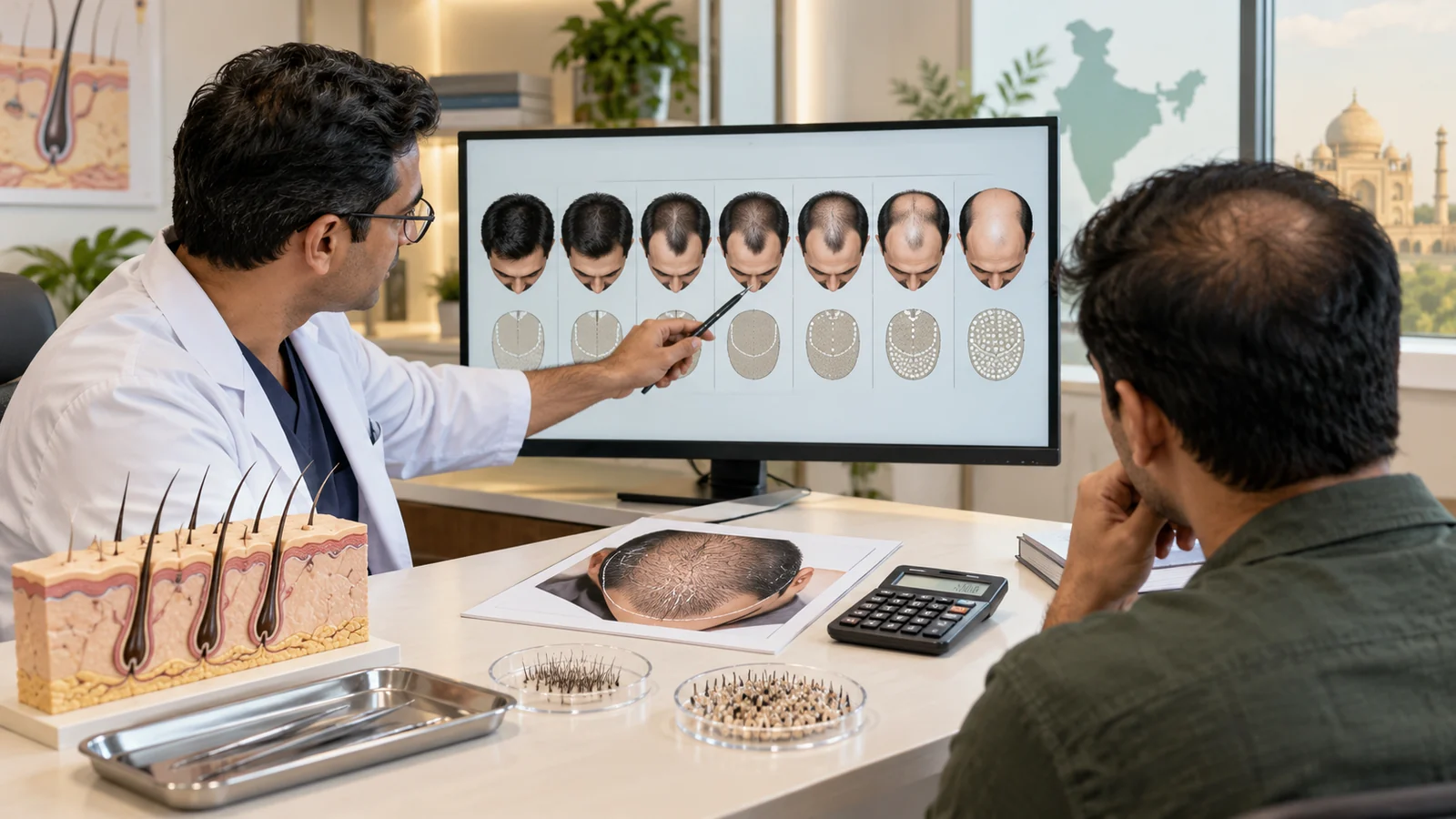
“How many grafts will I need?” It is the single most common question I hear in my consultation room in Chandigarh — usually before a patient has even sat down. And I understand why. The number of grafts decides the size of your surgery, the length of your session, and — because most clinics in India price per graft — what you will actually pay.
So let me answer it properly. In this guide I will walk you through realistic graft counts for every Norwood stage, explain what makes your personal number higher or lower, and show you why two men with the “same” baldness can need very different plans. Everything here comes from my own planning process at NeoGraft — the same worksheet I use with patients every week.
Why “How Many Grafts” Is the Wrong First Question
Before the number, a caution. Grafts are not a commodity you buy by the thousand. A graft is a living follicular unit containing one to four hairs, and your donor area — the permanent zone at the back and sides of your scalp — holds a finite lifetime supply, typically around 6,000 to 8,000 safely extractable grafts for most Indian men.
Every graft I move today is a graft you cannot use at 50. So the real question is not “how many grafts can I get?” but “how many grafts does my pattern need, and how do we spend my donor reserve intelligently across my lifetime?” A surgeon who quotes you a graft number over WhatsApp without examining your donor density, hair caliber, and family pattern of loss is guessing — and you will live with that guess permanently.
The Norwood Scale in 60 Seconds
The Norwood–Hamilton scale is how surgeons worldwide grade male pattern baldness, from Stage 1 (no meaningful loss) to Stage 7 (only the horseshoe rim remains). It matters because graft requirements do not rise gradually — they jump steeply once the crown joins the party. A receding hairline is a few thousand square millimetres of skin; a bald crown plus a bald front is many times that area.
At your consultation I photograph your scalp, assess it under magnification, and grade you honestly. Patients are often one stage further along than they believe, because mirrors hide the crown.
Graft Requirements by Norwood Stage
Here are the working ranges I use when planning surgery. These are typical figures for Indian hair, which averages a good shaft diameter — thicker hair covers more with fewer grafts.
| Norwood Stage | What It Looks Like | Typical Graft Range |
|---|---|---|
| Stage 2 | Early temple recession | 500 – 1,200 |
| Stage 3 | Deep temporal recession, the first “true” baldness | 1,000 – 1,800 |
| Stage 3 Vertex | Stage 3 hairline plus a thinning crown | 1,500 – 2,500 |
| Stage 4 | Larger frontal loss, enlarging crown, band still separates them | 1,800 – 2,800 |
| Stage 5 | The band between front and crown is breaking down | 2,800 – 4,000 |
| Stage 6 | Front and crown have merged into one bald area | 4,000 – 5,500 |
| Stage 7 | Only the horseshoe rim remains | 5,000 – 6,500+, often staged over two sessions |
Two honest notes on this table. First, at Stages 6 and 7 the demand for grafts can exceed what any donor area can supply, so we prioritise: frame the face first, restore the front and mid-scalp, and treat the crown conservatively or with medication. Second, these ranges assume a single goal of natural, age-appropriate coverage — not the artificial density of a wig. Chasing teenage density on a Stage 6 scalp is how patients end up needing repair surgery elsewhere.
What Moves Your Number Up or Down
Two patients at Norwood 4 can need 1,800 and 2,800 grafts respectively. Here is what decides where you fall in the range.
Hair caliber and curl. Thicker, slightly wavy hair — common across Punjab, Haryana and north India — gives more visual coverage per graft. Fine, straight hair needs more grafts for the same look.
Contrast between hair and skin. Dark hair on lighter skin shows thinning more, and demands higher density at the hairline. Lower contrast is forgiving.
Hairline design. A conservative, mature hairline can save 400–600 grafts compared with an aggressively low one — and it ages far better. I design hairlines for the 55-year-old you will become, not just the 30-year-old in my chair.
Donor quality. Donor density, scalp laxity and the size of your safe zone put a hard ceiling on any plan. This is measured, not assumed.
Future loss. If you are 26 with a strong family history of Stage 6 baldness, I plan today’s grafts knowing tomorrow’s loss. That may mean fewer grafts now plus medical therapy to hold what you have.
Grafts and Cost: How the Number Becomes a Bill
Because most Indian clinics price per graft, your graft count is effectively your quotation. This is also where patients get misled: some clinics inflate graft counts to inflate bills, or split follicular units to make one graft look like two. Always ask how grafts are counted and whether the count is verified during surgery.
I have written a full, honest breakdown of per-graft pricing across India — what different price bands actually buy you, and the questions that protect you — in my guide to hair transplant cost per graft in India (2026). Read it alongside this article: the graft number and the per-graft rate together are your real cost, and clinics that hide one of the two are usually hiding it for a reason.
How We Plan Grafts at NeoGraft in Chandigarh
At NeoGraft, every plan starts with measurement, not marketing. Using the NeoDHT® protocol, we map your donor density under magnification, calculate the recipient area in square centimetres, and set a target density zone by zone — highest at the hairline where the eye judges naturalness, graded behind it where layering does the work. Because NeoDHT® implants grafts with minimal time outside the body, graft survival stays high, which means the number we plan is the number that actually grows — you are not paying for grafts that die in a petri dish.
You leave your consultation with a written graft plan: your Norwood stage, your measured donor capacity, the graft count zone by zone, and what we are deliberately holding in reserve for the future. That document is yours whether or not you choose surgery with us.
Frequently Asked Questions
How many grafts do I need for a receding hairline only?
Most pure hairline cases (Norwood 2–3) need 1,000 to 1,800 grafts. If your crown is also thinning, budget for more or plan a second session.
Is 3,000 grafts enough for a fully bald head?
No. A genuinely bald Stage 6–7 scalp needs 4,000 grafts or more for meaningful coverage, and even then we prioritise the front over the crown. Anyone promising full coverage of a Stage 7 scalp with 3,000 grafts is setting you up for disappointment.
Can all the grafts be done in one day?
Sessions up to roughly 3,000–3,500 grafts are routinely done in a single day. Larger plans are safer and give better graft survival when staged over two days or two sittings some months apart.
Do transplanted grafts fall out?
Many shed their hair shafts between weeks 2 and 8 — this is normal shock shedding. The roots remain, and new growth appears from month 3 or 4, maturing over 12 months.
How do I know a clinic is not inflating my graft count?
Ask for your graft count in writing before surgery, ask how follicular units are counted, and ask to see the counting process on the day. An ethical clinic will not hesitate on any of the three.
Ready for a graft plan based on measurement rather than guesswork? Book your free consultation — NeoGraft Hair Clinic — SCO 3009-3010, Sector 22D, Chandigarh — myneograftindia.com
— Dr. Nav Vikram | NeoGraft Hair Clinic, Chandigarh