
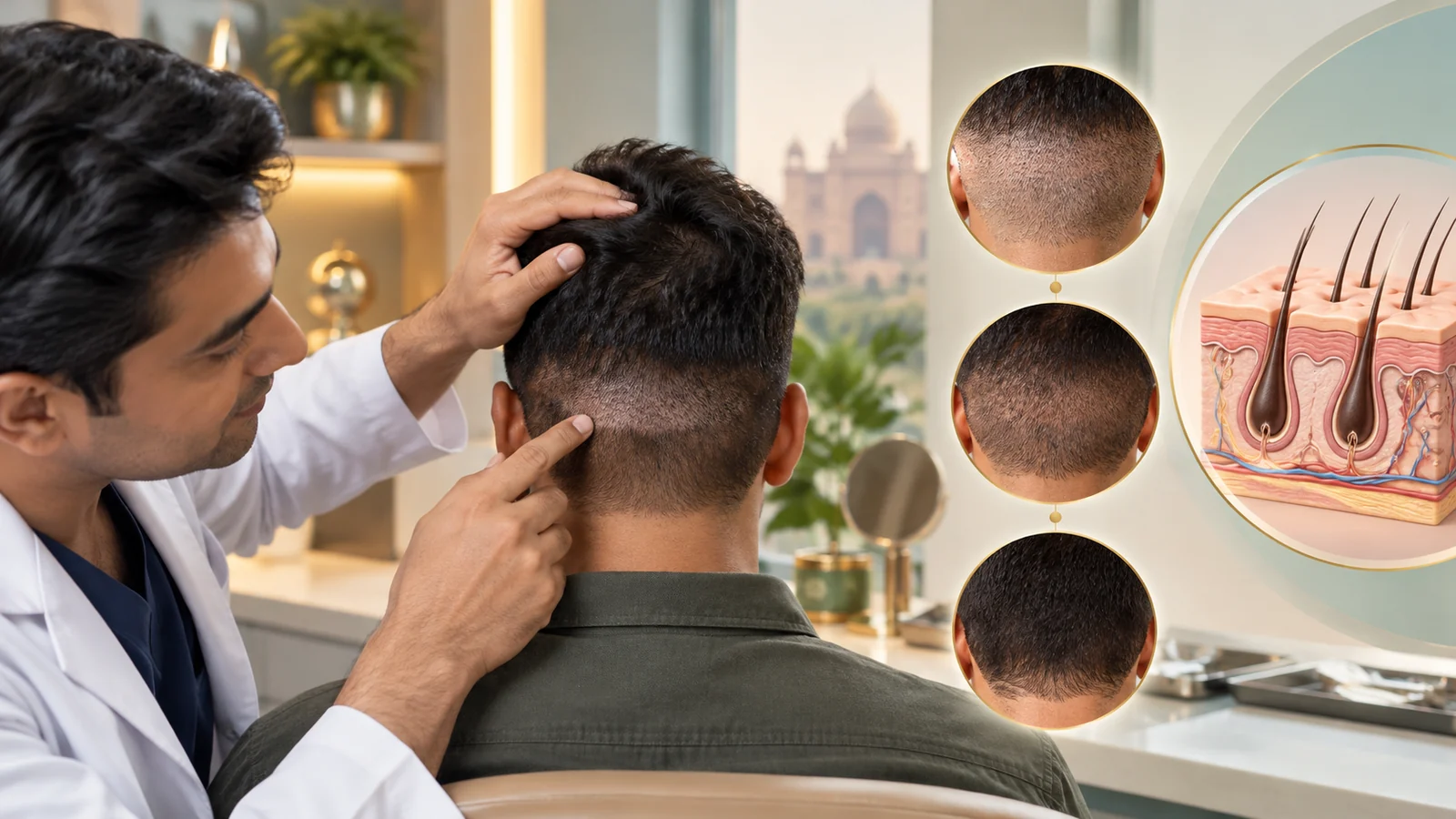
Almost every patient who sits across from me at my clinic in Sector 22D asks some version of the same question — usually in a lower voice, as if it embarrasses them: “Doctor, the new hair is fine, but what about the back of my head? Will people be able to tell?”
It is a sensible question. In a hair transplant, all the attention goes to the hairline — the part you see in the mirror. But the donor area at the back and sides of your scalp is where the entire procedure actually begins, and in my experience it is the part that separates a well-planned transplant from a regrettable one. A beautiful hairline built on a damaged donor area is not a success. It is a debt that comes due in five years.
So let me walk you through exactly what happens to your donor area — during the procedure, in the weeks after, and years down the line — the same way I explain it in my consultation room.
What the Donor Area Actually Is — and Why It Matters So Much
The donor area is the horseshoe-shaped band of hair at the back and sides of your scalp. The follicles here are genetically different from the ones on top of your head: they are largely resistant to DHT, the hormone responsible for male pattern baldness. That resistance is the entire reason hair transplants work — we move DHT-resistant follicles to DHT-vulnerable areas.
But here is the part most patients are never told: your donor area is a fixed, non-renewable bank account. You have a limited number of safely extractable grafts in a lifetime — not per procedure, per lifetime. Every graft removed is a graft you can never get back. This is why, at NeoGraft Hair Clinic, donor-area planning comes before hairline design, not after. We first ask what your scalp can safely give — over your whole life, including a possible second session years from now — and only then decide what to build with it.
During the Procedure: What Extraction Really Does
In an FUE procedure — including our NeoDHT® protocol — individual follicular units are removed with a small circular punch, typically under a millimetre in diameter. Two things about this matter for your donor area.
First, extraction is permanent removal. The follicle does not grow back in the donor spot. What protects the appearance of the donor area is not regrowth of extracted follicles — it is the fact that we take follicles in a scattered, non-adjacent pattern, leaving the majority of units in every zone untouched so the remaining hair visually covers the area.
Second, spacing discipline is everything. When a clinic tries to take too many grafts from too small an area in one sitting — usually to advertise a big graft number — the donor area develops a moth-eaten, patchy look that becomes obvious the moment the hair is cut short. I see this regularly in patients who come to me for repair work after a cheap procedure elsewhere. The extraction pattern, punch size and per-zone limits are surgeon-level decisions, which is why I personally plan and supervise every donor harvest at our clinic. Graft handling on the way out matters just as much as placement — I have explained why in my guide to graft survival rates in Indian hair transplants.
Week by Week: The Honest Healing Timeline
Days 1–3. The donor area is covered with tiny scabs at each extraction point. There is mild soreness and a feeling of tightness. Most patients describe it as sunburn-like rather than painful.
Days 4–10. Scabs dry and begin to fall away on their own. Redness starts fading. In most of my patients the donor area looks unremarkable to a casual observer by the end of the second week, especially once the surrounding hair has grown out slightly.
Weeks 2–6. Residual pinkness settles. Some patients feel temporary numbness or itching — this is nerve-level healing, and it resolves on its own in the large majority of cases.
Months 2–4. This is when some patients panic: existing donor hair around the extraction sites can shed temporarily. This is shock loss, and in the donor area it is almost always temporary — the follicles are still there, and the hair returns as the growth cycle restarts. It is the single most common reason for an anxious phone call at month two, and it deserves patience, not panic.
Months 6–12. The donor area reaches its long-term appearance. With conservative extraction, it should look like a slightly less dense version of what you started with — noticeable only if someone is searching for it with a trimmer-short haircut.
Does Donor Hair Grow Back?
Let me answer this precisely, because clinics routinely blur it. The follicles we extract do not grow back — they now live on top of your head. The follicles we leave behind continue growing normally, and any shocked hairs among them return over a few months. So the correct expectation is this: your donor density is permanently reduced by roughly the proportion of grafts taken, and a well-planned harvest keeps that reduction visually undetectable at normal hair lengths.
If a clinic tells you “donor hair grows back fully, take as many grafts as you like” — that is not biology, that is sales.
How We Protect the Donor Area at NeoGraft
Donor management is one of the reasons I built the NeoDHT® protocol the way I did. Three principles guide every case at NeoGraft Hair Clinic.
First, lifetime planning. We estimate your total safe donor capacity before your first procedure and deliberately keep a reserve, because male pattern baldness progresses and many patients benefit from a second session in their forties or fifties.
Second, conservative extraction density. We spread extractions evenly across the safe zone rather than strip-mining the most convenient patch. The goal is that at a normal haircut length, nobody — including your barber — should be able to tell.
Third, protecting what remains. Because donor follicles are DHT-resistant but the rest of your native hair is not, the medical side of NeoDHT® focuses on stabilising the hair around and above the transplant, so the overall picture stays natural as you age. Aftercare and nutrition matter here too — I have covered exactly what to eat in the first four weeks of recovery in a separate guide.
Donor-Area Red Flags You Should Never Ignore
Healing problems in the donor area are uncommon, but I want my patients to know the difference between normal and not-normal. Increasing pain after the first week, spreading redness, pus or discharge at extraction points, or fever are signs of possible infection and need a same-day call to your surgeon — not a home remedy. Similarly, if months later your donor area shows visible patches, thin horizontal bands, or a see-through look under short hair, get it assessed. Over-harvesting can sometimes be camouflaged or partially repaired, but it needs an honest surgical evaluation first.
FAQ: Donor Area After Hair Transplant
How long does the donor area take to heal after FUE?
Surface healing is quick: scabs typically clear within seven to ten days, and by two weeks the area usually looks unremarkable. Deeper healing — numbness settling, shocked hairs returning — can take two to four months.
Will the back of my head look bald after a hair transplant?
Not if the extraction is planned properly. A conservative, scattered harvest leaves the donor area looking like a slightly softer version of its original density. Visible patchiness usually means too many grafts were taken from too small an area.
Does donor area hair grow back after extraction?
Extracted follicles do not grow back — they are permanently relocated. Hair around the extraction sites that sheds from temporary shock loss does return, usually within three to four months.
Can I wear a helmet or get a haircut after my transplant?
At our clinic we generally advise waiting before helmets and machine haircuts touch the donor area — your surgeon will give you exact timelines based on your healing. This is one reason local follow-up in Chandigarh is genuinely useful compared to operate-and-fly arrangements.
How many grafts can be safely taken from the donor area?
It varies with your donor density, hair characteristics and future balding pattern — which is why any clinic quoting you a huge graft number without examining your donor area should worry you. The honest answer comes from a scalp examination, not a price list.
The Bottom Line
Your donor area is the foundation of every result we build. Guard it, plan it for a lifetime, and a hair transplant can look natural at every age and every haircut length. Spend it carelessly, and no hairline — however artistic — can compensate.
If you are considering a transplant, or you are worried about how a previous clinic treated your donor area, come and let me examine it properly.
Book your free consultation — NeoGraft Hair Clinic — SCO 3009-3010, Sector 22D, Chandigarh — myneograftindia.com
— Dr. Nav Vikram | NeoGraft Hair Clinic, Chandigarh