
Before you book a hair transplant consultation anywhere in India, I want you to read this — not as a sales pitch, but as the honest briefing I give every patient who sits across from me in my clinic in Chandigarh.
Over 15 years and 10,000+ procedures, I’ve seen patients who made excellent decisions and patients who didn’t — and the difference almost always came down to one thing: whether they understood what FUE hair transplant in India actually involves before they signed a consent form.
What Is FUE Hair Transplant and Why Does India Lead the World in It?
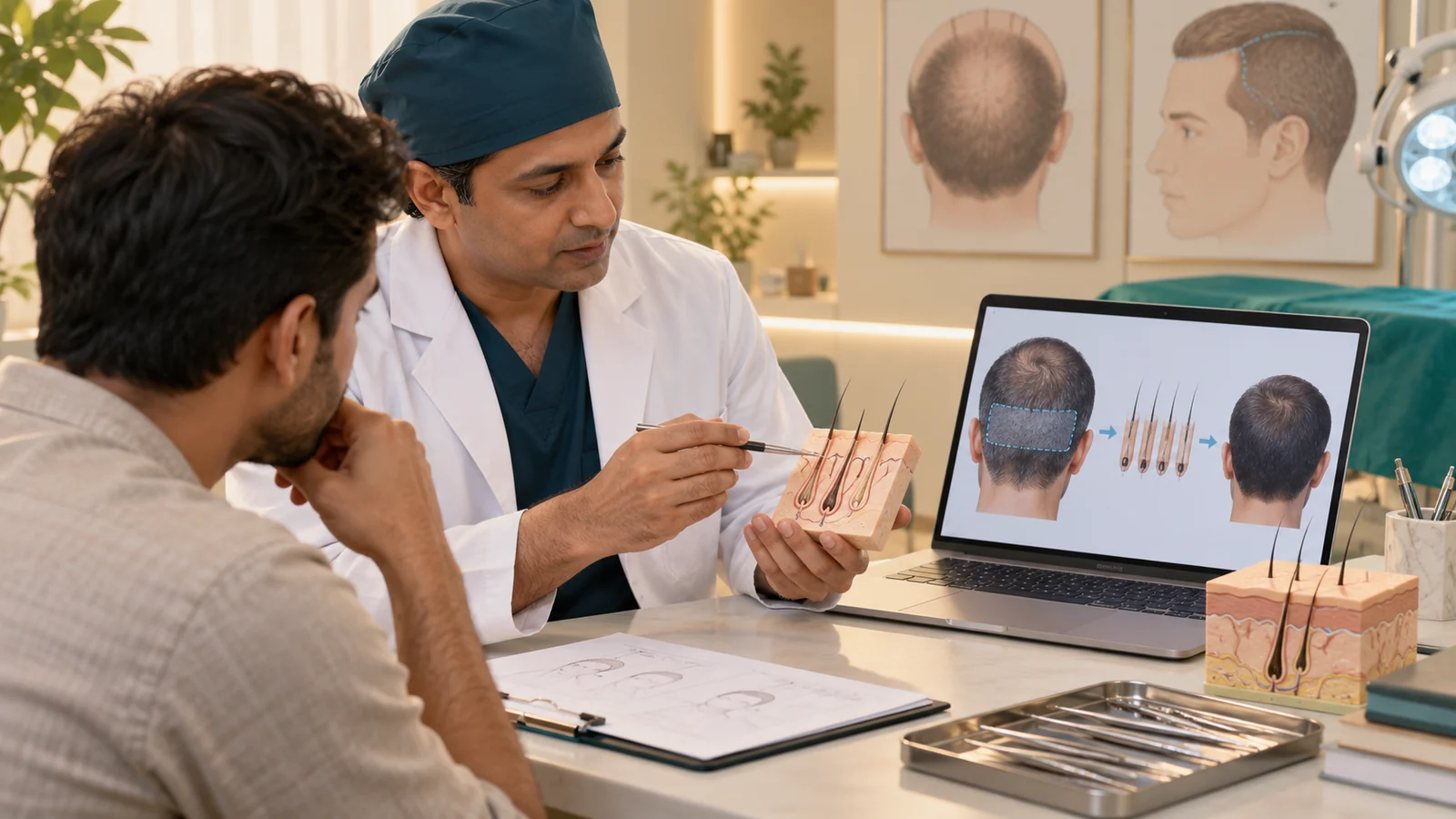
Follicular Unit Extraction — FUE — is the gold standard for hair transplantation globally. Unlike the older FUT (strip) technique, FUE removes individual hair follicle groups (grafts) one by one from the donor area at the back of the scalp, then implants them in the thinning or bald zones. The result: no linear scar, faster recovery, and natural-looking density that grows from your own follicles.
India has become one of the world’s top destinations for FUE hair transplant for three reasons: surgeons here train in extremely high-volume environments, costs are a fraction of Europe or the US, and Indian surgeons understand DHT sensitivity patterns unique to Indian patients from daily clinical experience.
But what most marketing hides: FUE is a spectrum. A basic FUE at a budget chain and a precision FUE performed by a trained surgeon using advanced protocols are entirely different procedures. The difference shows up years later in your mirror.
The DHT Problem: Why Standard FUE Often Isn’t Enough
DHT — dihydrotestosterone — is the hormone responsible for male pattern hair loss. It miniaturizes hair follicles over time until they stop producing hair. The key fact most patients miss: DHT keeps working after a transplant.
Transplanted grafts from the donor zone are genetically DHT-resistant — they survive permanently. But the surrounding native hair in the recipient zone continues to miniaturize unless DHT activity is actively managed. I’ve seen patients with excellent FUE results at year one who, by year four, had transplanted islands of hair surrounded by thinned native hair — because no one managed the DHT. This is exactly what NeoDHT® was built to solve.
The NeoGraft Approach: NeoDHT® and NeoPlatinum FUE
NeoDHT® FUE is our flagship protocol for androgenetic alopecia. It combines precision FUE with a pre-treatment DHT-blocking protocol that prepares the scalp environment before the first graft is placed. We consistently achieve 99–100% graft survival, and we actively reduce the post-transplant miniaturization that quietly undermines results elsewhere. Every step — from extraction to recipient site creation to implantation — is performed by me personally.
NeoPlatinum FUE is our premium protocol for maximum density. It combines FUE with PRP therapy and advanced graft handling to achieve 94–95% graft survival even in complex cases — including patients with previous failed transplants or high Norwood grades.
What Patients Get Wrong About FUE in India
“More grafts = better result.” This is the most common error. A well-planned 2,500-graft session produces a more natural result than a poorly designed 4,500-graft session. Graft survival rate, hairline design, and distribution logic matter more than raw graft count.
“The cheapest FUE clinic is fine — it’s all the same procedure.” It is not. In India, there is no standardized FUE protocol. Ask specifically: who performs the extraction, and who creates the recipient sites?
“I’ll get one transplant and I’m done.” Hair loss is progressive. A 28-year-old with Norwood Grade 3 thinning today may be Grade 5 by 40. A good surgeon plans around your projected future hair loss trajectory.
Your FUE Journey at NeoGraft
Before: Full scalp analysis, DHT sensitivity assessment, hairline design planning, and frank discussion of achievable outcomes. Outstation patients (Delhi, Mumbai, Bangalore) receive video consultations first.
Surgery day: 6–10 hours under local anaesthesia. I perform both extraction and recipient site creation. Grafts are placed under microscopic conditions with attention to natural hair direction, angle, and density gradients.
Recovery: Return to desk work in 3–5 days. Grafts shed at weeks 2–4 (normal). New growth from 3–4 months. Final assessment at 12 months.
Post-transplant: DHT protocol continues after surgery with reviews at 1, 3, 6, and 12 months. The goal is a result that holds up for the rest of your life — not just a good photo at month six.
Frequently Asked Questions
How much does FUE cost in India in 2026? Costs vary by graft count and technique. Transparent pricing at myneograftindia.com/hair-transplantation-cost/. Free consultations available.
Is FUE permanent? Transplanted follicles are permanent (DHT-resistant donor grafts). But surrounding native hair continues to thin without DHT management — which is why our NeoDHT protocol includes ongoing management as part of the complete treatment.
How many grafts do I need? Depends on Norwood grade, donor density, hair calibre, and scalp laxity. Most patients with moderate loss need 2,000–3,500 grafts. A full assessment is needed before any number can be quoted responsibly.
The Honest Bottom Line
FUE hair transplant in India is one of the best medical investments a man with significant hair loss can make — when done right. But “done right” requires a surgeon who understands DHT dynamics, plans for your future hair loss trajectory, and performs the procedure with precision from extraction to implantation.
If you’re considering FUE hair transplant in India and want an honest assessment of your case — without pressure to book — schedule a free consultation at NeoGraft Hair Clinic, Chandigarh.
Book your free consultation at myneograftindia.com
NeoGraft Hair Clinic | SCO 3009-3010, Sector 22D, Chandigarh 160022 | +91 904-199-9199