
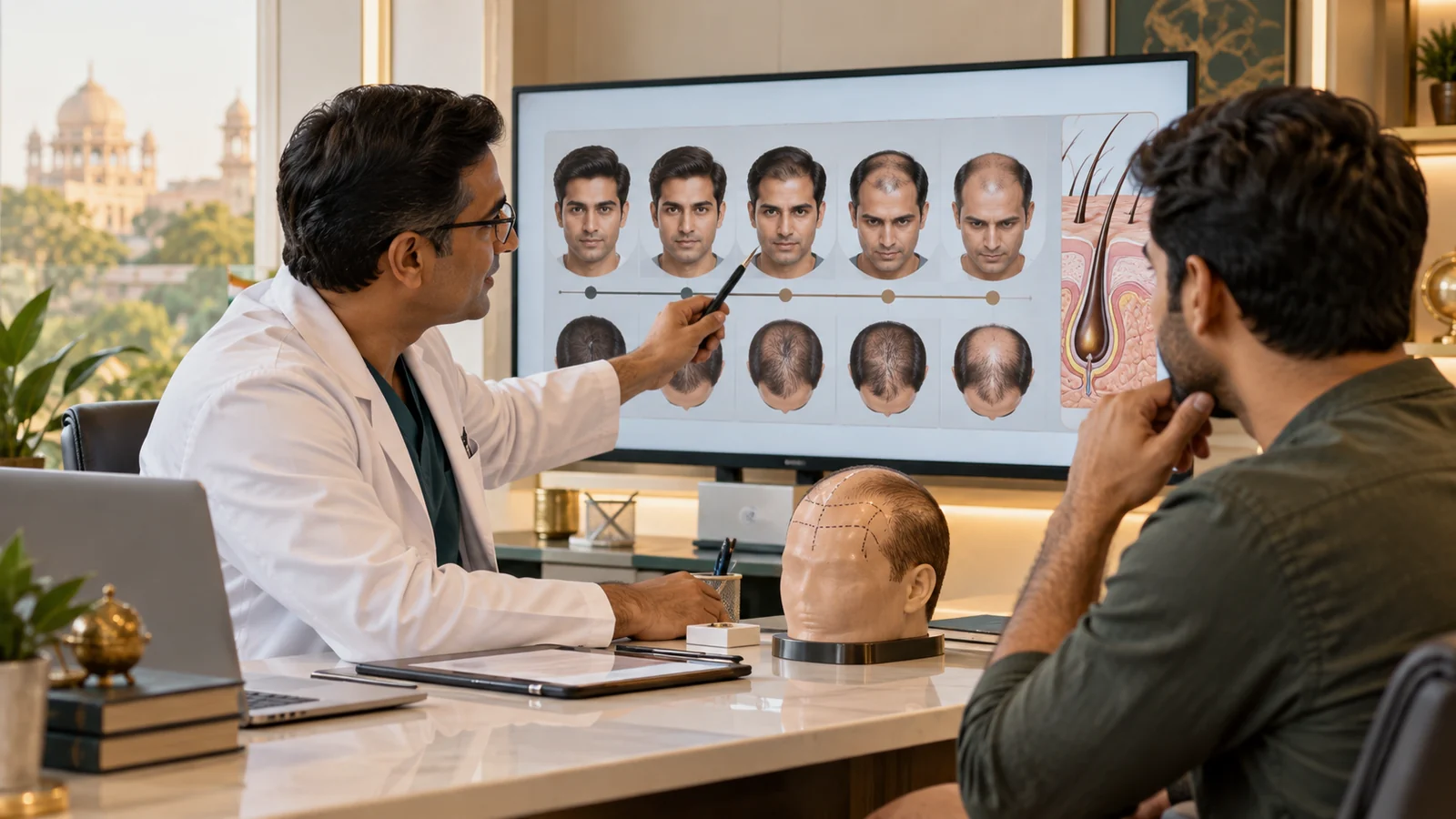
Of all the questions I hear in the consultation room, this one comes up more than almost any other: “What is the best age for a hair transplant?” I have heard it from 22-year-olds in panic after noticing a receding hairline, from 38-year-olds who waited and are now wondering if they waited too long, and from 55-year-olds who assumed hair restoration was no longer an option for them. The short answer is that there is a meaningful age window, and the reasoning behind it is rooted in biology, not opinion.
Why Age Matters More Than You Think
Hair transplantation moves healthy, DHT-resistant follicles from your donor zone to areas where hair has thinned or been lost. Once transplanted, these follicles are permanent. The complication: the transplanted hair is permanent, but the native hair surrounding it is not. Hair loss in most Indian men with genetic male pattern baldness is a progressive condition. If a patient receives a transplant at age 22 but the loss pattern has not stabilised, native hair around the transplanted zone may continue to fall out – creating an island of dense transplanted hair surrounded by a spreading bald zone. This is why surgical timing is as important as surgical technique.
The Ideal Age Window: 28 to 45
Based on my 15+ years of practice and over 10,000 procedures, I consider 28 to 45 to be the most favourable window for most Indian male patients. By the late twenties, most men with genetic hair loss have a clearer pattern – we can see which zones are affected, how the hairline is moving, and whether the vertex is thinning. This information is essential for planning a result that will remain natural-looking as the patient ages. Medical management tools – DHT-blocking agents and scalp treatments – can also reasonably stabilise ongoing loss before the procedure.
As patients move into their late forties and fifties, hair loss has usually stabilised – which actually makes surgical planning more predictable. Donor hair is often still robust, and the goal is restoring a natural hairline and improving density rather than recreating the density of a 25-year-old. Patients in this window achieve excellent, lasting results.
“The best age for a hair transplant is not a number – it is a biological state. When the pattern is predictable, the donor zone is healthy, and medical management is in place, the timing is right.”
Dr. Nav Vikram Kamboj, Director, NeoGraft Hair Clinic, Chandigarh
What About Patients Under 25?
In my practice, I am very cautious about performing hair transplants on patients under 25, and I decline in most cases unless certain conditions are met. The primary concern is unpredictability: male pattern baldness in young Indian men can progress rapidly. A young man at Norwood Grade 2 at age 21 may reach Norwood Grade 5 or 6 by age 35 – making even a well-planned early transplant look incomplete within a decade. There are exceptions – patients with a well-documented, stable pattern over 12+ months – but surgery must always be paired with comprehensive DHT management.
Dr. Vikram’s Clinical Tip: If you are under 25 and experiencing hair loss, begin medical DHT management immediately under supervision. Stabilising your loss medically before you are a surgical candidate can preserve far more native hair, reduce the number of grafts you eventually need, and dramatically improve your final outcome. Do not rush into surgery.
What About Patients Over 50 or 55?
Many patients over 50 assume they are too old for a hair transplant. This is almost never true. For patients in their fifties and sixties, hair loss has usually stabilised – which is an advantage for surgical planning. We know exactly what we are working with. Many patients in this age group achieve genuinely transformative results, because their expectations are calibrated and their hair loss pattern is fully predictable. The key considerations are general health, any medications affecting bleeding or wound healing, and realistic goal-setting.
Age by Hair Loss Grade – Practical Reference
| Age Group | Typical Situation | Recommendation |
|---|---|---|
| 18-24 | Early or actively progressing loss | Medical management only. Surgery rarely appropriate. |
| 25-29 | Pattern becoming visible; may still progress | Medical stabilisation first. Surgery only if stable 12+ months. |
| 30-40 | Pattern largely established | Prime window. Best balance of donor health and predictability. |
| 41-50 | Pattern stable in most cases | Excellent candidates. High satisfaction rates. |
| 51-65 | Stable loss; conservative goals | Good candidates if general health suitable. Excellent results. |
The North India Context – Why It Matters for UP and Punjab Patients
Indian men from North India – Punjab, Haryana, Uttar Pradesh, Himachal Pradesh, Delhi NCR – show patterns of hair loss that can differ from Western populations in both onset age and progression rate. In my practice, I regularly see patients from Chandigarh, Lucknow, Amritsar, and Dehradun who begin noticing recession as early as their early twenties and reach Norwood Grade 4 or 5 by their mid-thirties. Genetic DHT sensitivity is often high, and environmental factors such as hard water exposure, dietary iron deficiency, and chronic stress amplify the rate of progression.
This earlier onset means that “wait for stabilisation” must be accompanied by active medical management – not passive observation. My approach for young patients in their mid-twenties from Lucknow, Punjab, or Haryana: start medical management immediately, monitor with trichoscopy every 6 months, and revisit the surgical conversation once stability has been demonstrated over 12 to 18 months. If you are wondering whether this is the right time for a hair transplant, book a free consultation at 9041999199 or visit myneograftindia.com.
Related Reading: Hair Transplant in Lucknow – Why UP Patients Travel to Chandigarh | Why Hair Transplants Fail – 5 Critical Reasons Indian Patients Must Know | Hair Transplant Recovery Guide
Director, NeoGraft Hair Clinic, Chandigarh. 10,000+ procedures over 15+ years. Specialist in NeoDHT(R) and NeoPlatinum FUE techniques. Serving patients from Punjab, Haryana, Himachal Pradesh, Delhi NCR, and across India. www.myneograftindia.com | Call: 9041999199